

As an entry-level analyst within the US State Department, and in response to a request from the assistant secretary, this policy hereby seeks to develop the necessary recommendations for the U.S.’s position on the International Criminal Court (ICC). This report will examine the independence of the ICC as an autonomous plurilateral punitive body whose operations directly threaten the sovereignty of its nonmembers; representing a distinct threat to America’s national security. The bottom line—the ICC’s jurisdiction needs to be regulated by the United Nations to preserve the Western judicial process, a justice system contingent on natural law by design, and the delegation of God’s power, (Isa 33:22).
Desired Outcome
The best course of action for U.S. policy regarding the International Criminal Court (ICC) is for America to negotiate with the ICC and the United Nations to develop an enforceable hierarchy of international judicial process. Accordingly the US should formally denounce the ICC’s authority jurisdiction under the authority of the United Nations. Hegemons are obligated to repair broken nations through righteous actions, backed the God and natural law, (Isa 58). But the ICC is an inherently biased institution whose autonomous operations have produced unnecessary conflict in domestic foreign affairs. Therefore, it is in the best interests of the United States to limit the sovereignty of the ICC, to comport with the United Nations’ member states’ expectations. This policy seeks to invest a patient endurance contingent on faith, (Rev 2:19). Thus, the International Criminal Court must be made formally accountable to United Nations, delegated to its General Assembly; and enforced by its members.
Brief Background
The International Criminal Court (ICC) was created in 1998 in Rome. The International Criminal Court (ICC) was ratified by treaty, designated as “the Rome Statute,” it “grants the ICC jurisdiction over four main crimes,” (ICC, 2020). The Rome Statute enacted “definitions of genocide, war crimes, and crimes against humanity, functionally they were ‘unclear and strongly contested.’” (Newquist, B., p. 695). These include (1) genocide; (2) crimes against humanity; (3) war crimes; and (4) crimes of aggression, (ICC, 2020).
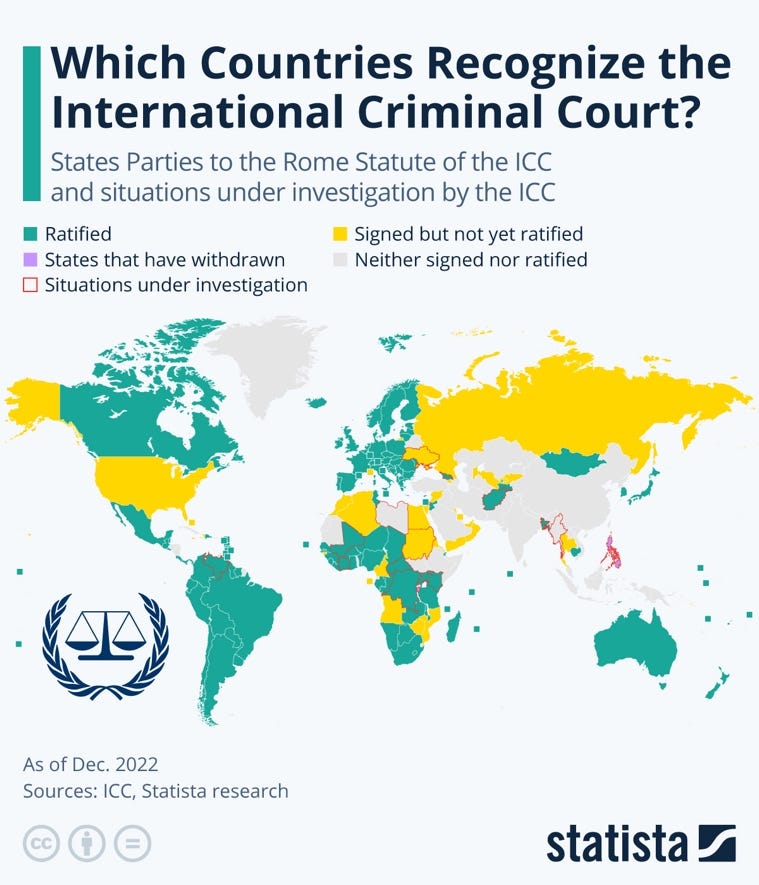
While “[t]here are 124 countries party to the Rome Statute . . . forty countries never signed the treaty, including China, Ethiopia, India, Indonesia, Iraq, North Korea, Saudi Arabia, and Turkey,” (CFR, 2025).
- In 2000, President Bill Clinton “signed the Rome Statute . . . but did not submit the treaty to the Senate for ratification,” (HRW, 2020).
- In 2002, President George W. Bush “’unsigned’ the treaty, sending a note to the United Nations secretary-general that the US no longer intended to ratify the treaty and that it did not have any obligations toward it,” (HRW, 2020).
- In 2017, President Donald Trump ‘hardened opposition to the ICC’ in his first term
- In 2021, the Biden administration took “a more conciliatory approach,” (CFR, 2025).
- The Council on Foreign Relations (CFR) believes that now, in 2025, “Trump’s second term is set to revive those tensions,” (CFR, 2025).
The Trump administration is in a strong position to deescalate ICC tensions, through cutting a deal with the United Nations’ (UN) 193 member states; thereby reigning in the autonomy of the International Criminal Court (ICC) to operate under UN jurisdiction. The Trump Administration has already begun its imposition of sanctions over the ICC, citing that “[t]he ICC has no jurisdiction over the United States or Israel . . . neither country has ever recognized the ICC’s jurisdiction, and both nations are thriving democracies with militaries that strictly adhere to the laws of war, (WhiteHouse, 2025). Rather than governing by representation, the International Criminal Court is “[g]overned by an international treaty called the Rome Statute,” making “the world’s first permanent international criminal court,” (ICC, 2020).
In the modern context, the International Criminal Court (ICC) “investigates and, where warranted, tries individuals charged with the gravest crimes of concern to the international community,” (ICC). Yet many nations have chosen to opt out of this arbitrary multipolar collective alliance. The United States is one of many nations that do not recognize the International Criminal Court (ICC).
President Donald Trump declared that “[t]he United States will impose tangible and significant consequences on those responsible for the ICC’s transgressions,” (WhiteHouse, 2025). He added that it would likely include “the blocking of property and assets, as well as the suspension of entry into the United States of ICC officials, employees, and agents, as well as their immediate family members,” (WhiteHouse, 2025). The President believes that ICC’s self-imposed authority if left unchecked, would be “detrimental to the interests of the United States,” (WhiteHouse, 2025).
The ICC’s autonomous judicial activism is a direct threat to Western democracy and global diplomacy. The Council on Foreign Relations (CFR) reports that the ICC “since its inception,” has been “unable to gain the membership of several major powers, including the United States, China, and Russia” (CFR, 2025). The contrast between nations that formally recognize the International Criminal Court presents many significant issues in international relations. America, Russia, China, and many parts of Africa are now faced with a consequential contemporary threat to their own national security. But South America, Canada, Europe, Australia, New Zealand, Japan, West Africa, South Africa, Afghanistan, Palestine, and Mongolia, do not bear the authority to prosecute foreign leaders, especially of hegemonic nations.
Courses of Action (COA)
The top recommendations are COA 1: Abolition; COA 2: Military Intervention; and COA 3: Negotiation.
Course of Action 1: Abolish the ICC
The first course of action is COA1: Abolish the ICC. The International Criminal Court (ICC) should be collectively dismantled by its United Nations (UN) members, as nearly all its 125 nations are already part of the UN. The ICC is not only obsolete, but a burden for America’s international relations. The United Nations should establish a criminal court for international crimes through its International Court of Justice (ICJ).
Course of Action 2: Unitary Military Intervention
A second course of action is COA2: Military Intervention; formally declaring war on the Netherlands and its International Criminal Court headquartered in Hauge—an officially recognized threat to U.S. national security. The formal declaration of war against the Netherlands would begin with a 90-day suspension of physical conflict, allowing the Netherlands and the ICC time to negotiate its dismantlement. By imposing sanctions on the ICC and its members, the US could coerce the majority of its members to reject an independent intergovernmental court. The preclusion of physical conflict will be contingent on the dismantlement of the International Criminal Court.
Course of Action 3: Negotiation
A third course of action is COA3: Negotiation. The United States must negotiate with the International Criminal Court (ICC) and the United Nations to redact the international warrants for Russian President Vladimir Putin and Israeli Prime Minister Benjamin Netanyahu. By engaging in multipolar deliberations, America can achieve consensus amongst nations on the definition of international criminal justice. Accordingly, the United States can negotiate the reallocation of authority for the ICC’s future approvals of international warrants to be approved exclusively through the United Nations.
Analysis and Comparison
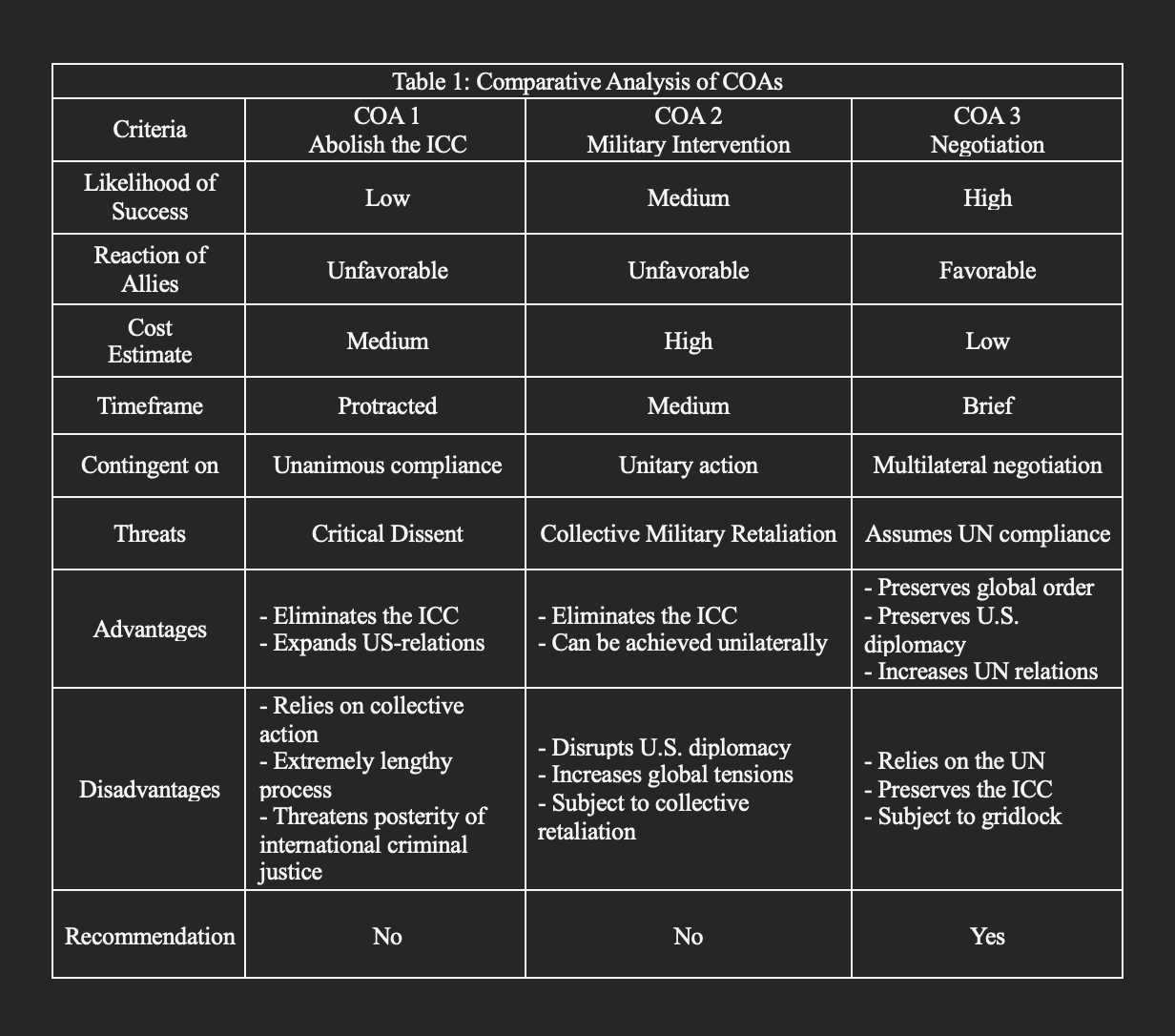
Best COA. The best course of action is COA 3: Negotiation. By negotiating with the International Criminal Court (ICC)—rather than dismantling it—the United States can execute immediate action. The United Nation’s Security Council is responsible for “international peace and security;” therefore, it should approve all warrants for the International Criminal Court, (Mingst & McKibben, p. 314). Moreover, the UN should limit the ICC’s punitive behavior to sentencing, not suspects. This would require the International Criminal Court (ICC) to abdicate “Pre-Trial judges” who “issue warrants of arrest and ensure there is enough evidence before a case can go to trial,” (ICC, 2020). Lastly, the International Criminal Court (ICC) must nullify the current international warrants for Russian President Vladimir Putin and Israeli Prime Minister Benjamin Netanyahu.
The International Criminal Court is not a traditional “judicial institution,” as it “does not have its own police force or enforcement body, (ICC, 2020). President Donald Trump declared that he found the International Criminal Court (ICC), had “engaged in illegitimate and baseless actions targeting America and our close ally Israel,” (WhiteHouse, 2025). Thus, the ICC’s judicial proceedings and legal actions must be realigned by institutional hierarchy to represent the UN—an authoritative body with concurrent member objectives.
COA1: Abolish the ICC is unlikely to be achieved by America alone. Instead, redirecting its authority to fall beneath the UN-umbrella will ensure that international justice is preserved. Political Scientist Darren Hawkins believes that COA1: Abolishing the ICC, id est pressuring smaller nations to leave the ICC “is a losing cause, it is unnecessary, and it focuses on less important features of the court,” (Hawkins, D., p. 115).
COA2: Military Intervention produces significantly more harm than it does good. While a full frontal assault against the tyrannic global institution is warranted, the U.S. must steward its diplomacy, ensuring it encourages consensus through righteous foreign conduct, (Luk 11:33–36).
on less important features of the Court.
Similarly, The International Criminal Court is “a permanent international court established to investigate, prosecute and try individuals accused of committing the most serious crimes of concern to the international community,” (ICC, 2020). COA1: Abolish the ICC, and COA2: Military Intervention are unlikely to be supported by the United Nations. Notably, “the United States became one of the first members” of . . . the United Nations,” (State, 2018). Unlike the ICC, the UN was established as an “international organization designed to promote international security, commerce, and law,” (State, 2018).
Success Rate. COA 3: Negotiation utilizes persuasion; thereby posing a far higher likelihood of success, than coercion by force or the threat thereof, (1Pe 3:15). COA1: Abolish the ICC is unlikely to reach consensus. Reassessing the hierarchy of the International Criminal Court’s (ICC) authority, tethered under the United Nations, is far more likely to resolve global tensions. Inversely, COA2: Military Intervention, is likely to heighten global tensions; resulting in the erosion of U.S. diplomacy. Thus, COA3: Negotiation is likely to succeed. Many nations view the ICC as “reluctant to convict state actors, only rebels,” (Mingst & McKibben, p. 377).
Negotiation has been favored as a means of dispute resolution since the inception of America. Founding Father Alexander Hamilton asked in the Federalist No. 11, “[w]ould it not enable us to negotiate, with the fairest prospect of success, for commercial privileges of the most valuable and extensive kind, in the dominions of that kingdom?” (Hamilton, A. p. 50). Moreover, Hamilton advocated “a vigorous national government, the natural strength and resources of the country, directed by common interest, would baffle all the combinations of European jealousy to restrain our growth,” (Hamilton, A., pp. 51, 52). The ICC is not directed by common interest, and therefore must be reassessed to ensure the greatest prospect of success. COA3: Negotiation must be conducted explicitly by common interests, thus remains the most likely COA to succeed.
Reaction. The reaction from allies will likely be favorable, as it will reduce global tensions caused by the existence of the ICC itself. Russia has already “withdrew its support of the ICC after a preliminary investigation of alleged crimes committed by Russian and Georgian forces during the 2008 war,” (Mingst & McKibben, p. 377).
The autonomy of the International Criminal Court (ICC) continues to produce significant unnecessary international tensions amidst the global state of anarchy. The ICC continues to threaten national acts of diplomacy. Unconventionally, the International Criminal Court (ICC) relies on “cooperation with countries worldwide for support, particularly for making arrests, transferring arrested persons to the ICC detention centre in The Hague,” (ICC, 2020). Additionally, the International Criminal Court wields a self-imposed authority by its members that allows “freezing suspects’ assets, and enforcing sentences,” of non-member nations, (ICC, 2020). The ICC’s unconventional judiciary represents a bipolar disbalance in the consensus of judicial process in the global court.
Further, “African states, once supporters of the ICC, are increasingly skeptical of its neutrality, arguing that the court is applying double standards and selectively (and unfairly) targeting African leaders,” (Mingst & McKibben, p. 377). Worse, “nine of the first ten ICC investigations [were] located in Africa,” leading “some African leaders [to] have claimed that the ICC is unfairly targeting the continent and is a tool of ‘western neo-colonialism.’” (CoalitionForTheICC).
Cost. The cost of COA3: Negotiation will be minimal as negotiations are the least expensive means of attempting resolution. Conversely COA1: Abolish the ICC will require extensive resourcing to establish some Western role of international criminal justice. Further, CO2: Military Intervention will require significant funding, if the U.S. is serious about upholding its conditions. Notably, “[t]he United States today remains the largest donor to the United Nations. It contributed close to $13 billion in 2023, accounting for more than a quarter of funding for the body’s collective budget,” (CFR). Thus, America should have significant influence in negotiating with the United Nations, and the ICC member states.
Timeframe. The duration until completion of COA3: Negotiation should be immediate, as the existence of the International Criminal Court (ICC) relies on UN member states. Unlike COA1: Abolish the ICC; and COA 2: Military Intervention, both requiring significant planning and investment of resources. Under COA1: Abolish the ICC, the absence of an international criminal court will require further policymaking. Under COA3: Negotiation is essential that the ICC work to quickly reform its practices to fall within the scope of the United Nations, to best reduce international tensions. Inversely, US alignment with the ICC would likely prove detrimental to America’s international relations with specific hegemons. The ICC has placed “warrants of arrest for national leaders,” which proves detrimental for diplomatic relations with foreign superpowers (CFR). The ICC’s warrants include “Russian President Vladimir Putin and Israeli Prime Minister Benjamin Netanyahu,” (CFR). America’s consent of an independent judicial criminal court produces significant externalities that can harm our nation.
Advantages. The advantages to COA3: Negotiation are achieving a solution without imposing unnecessary force; whereas the advantages of COA1: Abolish the ICC and COA2: Military Intervention are exclusively the removal of the institution itself. The United Nations’ 193 member states produce immediate diplomacy to a greater degree than an autonomous intergovernmental organization that excludes hegemonic states, (UN). The need for an international criminal court should be given to the discretion of the global organ of diplomacy, the United Nations. The UN is an intergovernmental organization that better represents the global hegemonies like China, Russia, and the United States; whereas the International Criminal Court has become an obsolete institution, one that ought to be supplanted by the United Nations—as its name, by design, implies. Further advantages include the preservation of judicial process; collective global policy cannot issue arbitrary judicial oversight over accusations of alleged international crimes.
Disadvantages. The disadvantages of COA3: Negotiation include relying on the UN to enforce its administration over the ICC. Should the United Nations fail to enforce its agreement between the International Criminal Court, its members would be unlikely successful in achieving the results intended by its protest. Nonetheless, these disadvantages should not deter the U.S. from a formal dissent against intergovernmental judiciary bodies that strive to prosecute foreign leaders. By contrast both COA1: Abolish the ICC; and COA 2: Military Intervention will severely increase global tension. Further, COA2: Military Intervention will disrupt U.S. diplomacy on the world stage. COA3: Negotiation may rely on the United Nations, but it preserves U.S. sovereignty; without relegating America to endorse criminal prosecution of non-members from an unrecognized international judiciary—the International Criminal Court (ICC).
Conclusion
In sum, the best recommendation is COA 3: Negotiation. America cannot relegate its foreign policy to intergovernmental bureaucracy. To best preserve America’s global image and its diplomacy, COA2: Military Intervention remains unfavorable. Similarly, COA1: Abolish the ICC induces relative dysfunction—thus likely to increase global tensions. Rather, under COA3: Negotiation, America must reinvest itself in national diplomacy, backed by the United Nations; thereby preserving the power of each nation’s sovereignty.
COA3: Negotiation places international warrants for arrests at the behest of the UN’s General Assembly, rather than granting exclusive autonomy to the International Criminal Court (ICC). The ICC has become an outdated entity, its dismantlement requires excessive effort. Reigning in the jurisdiction of the ICC, thereby limiting its authority to the decision of the UN members, will benefit the posterity of America’s capacity to conduct foreign policy with relative hegemons and collective international government organizations.
Bibliography
CFR. (Accessed on April 30th, 2025). Funding the United Nations: How Much Does the U.S. Pay? https://www.cfr.org/article/funding-united-nations-what-impact-do-us-contributions-have-un-agencies-and-programs
CFR. (Accessed on April 30th, 2025). The Role of the ICC. https://www.cfr.org/backgrounder/role-icc
Coalition for the ICC. (Accessed on May 1st, 2025). Africa and the ICC: Setting the Facts Straight. https://coalitionfortheicc.org/explore-international-criminal-court-africa-icc
Hamilton, A.; Madison, J.; Jay, J. (2001). The Federalist: The Gideon Edition.
Hawkins, D. (2008). Power and Interests at the International Criminal Court. The SAIS Review of International Affairs, 28(2), 107–119. https://www.jstor.org/stable/27000150
HRW. (Accessed on April 30th, 2025). Questions and Answers Questions and Answers about the ICC. https://www.hrw.org/legacy/campaigns/icc/qna.htm#:~:text=proceedings%20against%20Americans.-,How%20is%20the%20ICC%20different%20from%20the%20International%20Court%20of,tribunal%20that%20will%20prosecute%20individuals.
HRW. (Accessed on April 30th, 2025). Q&A: The International Criminal Court and the United States. https://www.hrw.org/news/2020/09/02/qa-international-criminal-court-and-united-states
ICC. (Accessed on May 2nd, 2025). About the Court. https://www.icc-cpi.int/about/the-court
ICC. (Accessed on May 1st, 2025). How the Court Works. https://www.icc-cpi.int/about/how-the-court-works
ICC. (Accessed on April 30th, 2025). The Presidency. https://www.icc-cpi.int/about/presidency
Mingst, K. A., McKibben, H. E. (2021). Essentials of International Relations, 9th Edition. [VitalSource Bookshelf 10.3.1]. Retrieved from vbk://9780393872033
Newquist, B. J. (2000). The International Criminal Court. The International Lawyer, 34(2), 691–696. http://www.jstor.org/stable/40707555
SGP. (Accessed on April 27th, 2025). https://sgp.fas.org/crs/misc/RL31495.pdf
WEF. (Accessed on May 2nd, 2025). Globalization: Retreat or Reinvention?https://www.youtube-nocookie.com/embed/XU2CkYTXra0?rel=0&autoplay=0&showinfo=0&enablejsapi=0

