


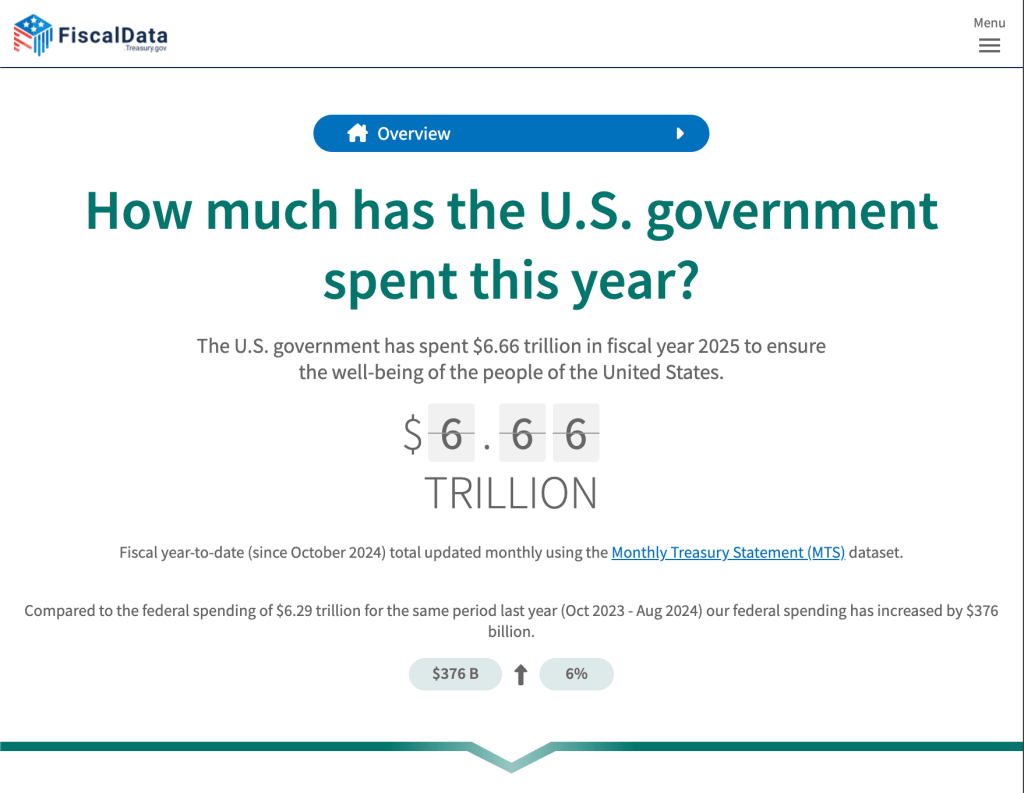
As of September 26th, 2025, the federal government has spent $6.66 trillion this fiscal year, “to ensure the well-being of the people of the United States,” according to data from the U.S. Department of the Treasury, (FiscalData.Treasury.gov). This debt stands as a disturbing reminder to America’s taxpayers. An investment of $6.66 trillion dollars should be revolutionary, yet instead the nation sits on the precipice of mass division and extreme regional disparities.
Despite the $6.66 trillion investment, America’s regional infrastructure and public education systems continue to erode at the behest of the government’s excessive foreign aid and other discretionary appropriations. Political violence is broadcasted and encouraged by government funded public media. Mainstream news commentators misconstrue accurate information to disperse the union and incite greater civic division.
While it’s unlikely the $6.66 trillion is a nefarious transmission from reptilian overlords, it is a potent warning for the nation’s posterity. The federal budget overtly grows, civic representation decreases. With a national debt of $37.47 trillion, America’s economic future must be addressed, (FiscalData.Treasury.gov). The U.S. government’s annual federal budget is absent of representation.
Illegal immigration has had severe impact on the lives of American citizens. New York City has already “committed $2.76 billion in FY 2025” to fund services for refugees seeking asylum. New York City Mayor Eric Adams has declared an Asylum Seeker Crisis, (NYC.gov). Currently, 42,700 people are seeking asylum in City-funded shelters, and over 233,000 have been reported since 2022, (Comptroller.NYC.gov). Eric Adams assured that “New York City is a city of immigrants and has always welcomed people with open arms,” but warned that “there is a limit and cost to a national crisis that we have been left to deal with on our own . . . Now it’s time for the rest of our state and federal government to do their part,” (NYC.gov).
But in fiscal year 2025 the Department of Education was awarded $83.92 billion in federal discretionary funding for public education, (Ed.gov). Of New York City’s $41.2 billion annual education budget, only $2.5 billion (6.2%) comes from federal funding. New York City is responsible for 57.3% of its public education budget, with 36% from New York State.
School facilities and utilities cost $2.2 billion (44%) of NYC’s total education budget, whereas student transportation costs $1.9 billion (38%), (Schools.NYC.gov). Public education is and should be the obligation of the states, but the absence of federal interest sends a dissuasive message of rejection to the American taxpayer, and impedes the fruition of national morale. Unregulated federal immigration has overburdened the states, forcing the state to care for the resettlement of a persistent influx of refugees. Federal grants can assist in the resettlement of refugees, and the Department of Homeland Security (DHS) can increase its funding, specifically to preserve our nation’s borders. The value of America’s public education system greatly outweighs statewide refugee resettlement.
As the Prophet Isaiah scribed in the Old Testament, “[h]ear that uproar from the city, hear that noise from the temple! It is the sound of the LORD repaying his enemies all they deserve,” (NIV, 2011, Isaiah 66:6). Here, the public response to the government’s alleged budgetary innovations is extremely unfavorable. The refutation of civic consensus is a call for the legislature to abdicate from its self-proclaimed autonomy.
The U.S. Treasury boasts of its investment into the American people, but the nation and its issues persist. As major U.S. cities surge with crime, America’s rural regions are forgotten. Policymakers continue to legislate self-enriching initiatives, as House representatives rely on rhetoric to ensure reelection. But the bottom line is that there remains a lack of accountability, obligation, and responsibility from the majority of America’s bureaucracy. Numbers like this leave the public to ask—how much will it cost to produce an observable improvement in the preservation of American polity?
 Jordan Muhsin