
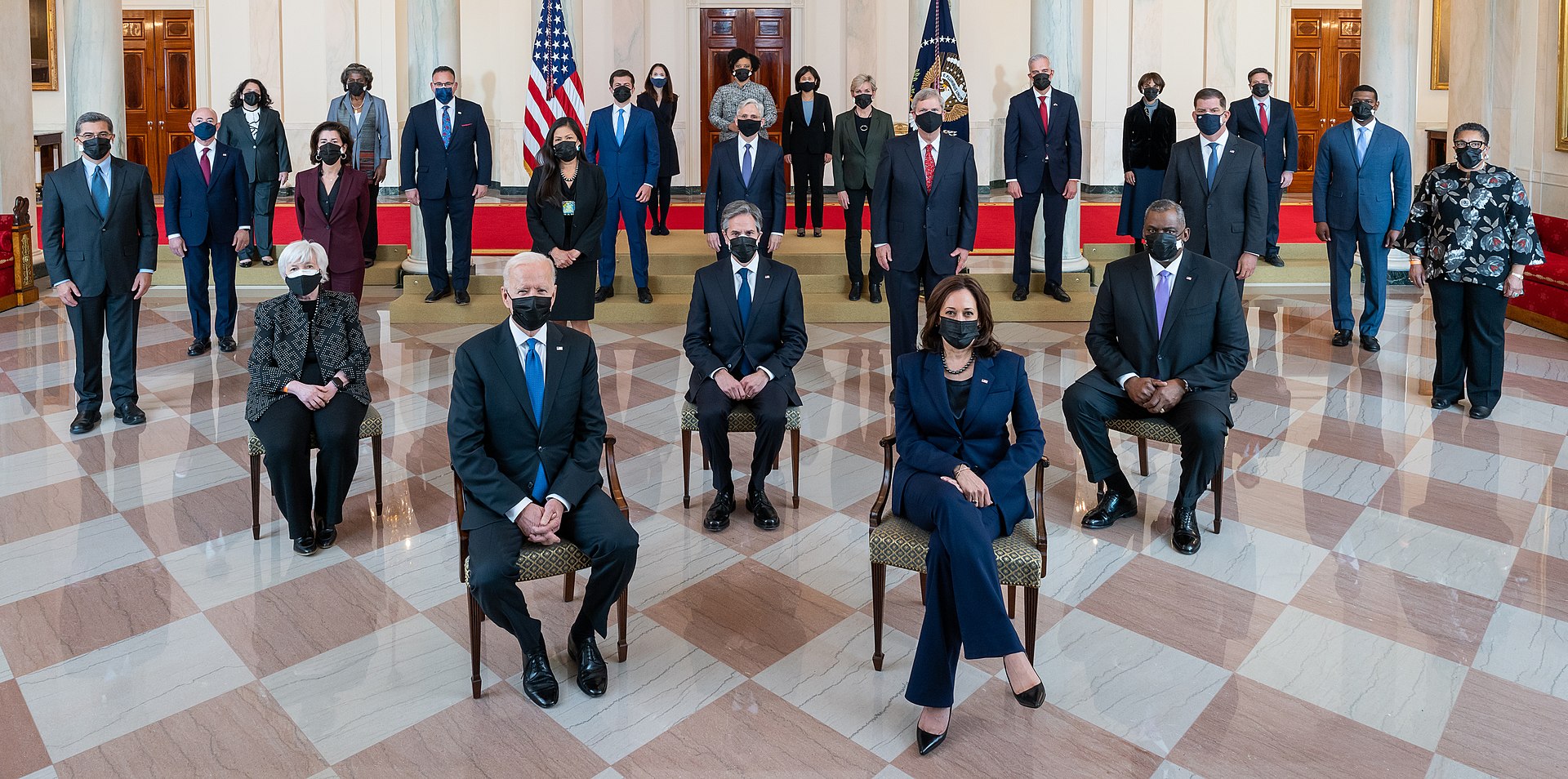

The bureaucratic politics model is the U.S. foreign policy analytical system that best represents former president Joe Biden’s executive decision to withdraw all U.S. forces from Afghanistan in August 2021. The bureaucratic politics model “focuses on negotiations among individuals that head various organizations within the government representing different interests,” (Mingst & McKibben, p. 163). Thus, “[w]here you sit influences what you see and where you stand,” (Mingst & McKibben, p. 163). It was the highest-ranking members of the Biden Administration who conducted the total withdrawal, resulting in a tragic aftermath.
Joe Biden’s withdrawal of troops from Afghanistan signaled a drastic shift in U.S. foreign policy. Biden’s executive actions were sources from a place a fear. Under a rational framework, diplomatic negotiations could have led to a better result. Joe Biden’s rapid immediate withdrawal overlooked left many essential details. His lack of strategy resulted in the loss of billions of dollars of U.S. military equipment, and “thirteen American service members killed in a terrorist attack at the Kabul airport,” (Pompeo, M., Hudson). On the “hundreds of Americans and tens of thousands of Afghan allies left behind,” General Milley retorted “[a]s far as the American citizens, it wasn’t clear then, and it’s still not clear to me, what those numbers are, and that was never clarified by anyone in the State Department,” (Congress, p. 47). Milley added, “[y]ou could look forever, because you do not even know what number you’re looking for. And you do not even know where they’re at,” (Congress).
A lack of accountability and severely distanced understanding evidences the bureaucratic nature of the abrupt withdrawal of Afghanistan. In the bureaucracy, all responsibility defers to the president, including the administration’s failures. Thus, the executive must steward their authority responsibly and delegate ad hoc rather than per librum. Scripture warns against the bureaucratic politics model, and the omission of our inherent sovereignty. Regarding leaders, the Bible reminds us to revere our autonomy, and “[h]old on to what you have, so that no one will take away your crown,” (Revelation 3:11; NLT).
Bureaucratic Politics Model
Biden’s decision was not a rational one; “[r]ather than being a rational decision, the ultimate policy choice depends on the relative strength of the relevant bureaucratic players,” (Mingst & McKibben, p. 163). Biden announced on August 16th, 2021, through his communications department that “[m]y national security team and I have been closely monitoring the situation on the ground in Afghanistan and moving quickly to execute the plans we had put in place to respond to every constituency,” (NATO).
Joe Biden’s withdrawal was overtly coordinated by the permanent bureaucracy and the key players of his own administration. Joe Biden’s lack of personal control over the situation is evident in his inability to justify what occurred, nor provide a rational strategy for its success. Instead, Biden’s administration relied on secrecy and immediacy to execute its process objective—but it did not attain the expected outcome objective
Joe Biden’s executive decision to withdraw U.S. troops from Afghanistan may have been initiated by Biden, but it was not planned, nor executed by the president. Instead, these operations were over-delegated by the president unto the Biden administration, resulting in the egregiously tumultuous withdrawal of U.S. troops, and the abandonment of America’s national honor.
Although the total withdrawal of U.S. troops marked an end to a twenty-year conflict, it allowed America to invest itself deeper into foreign wars like the Russian-Ukraine conflict, or Israel-Palestine conflict. The weapons left behind were taken by the Taliban and sold to Ukraine to fight against Russia, (Cato). The equipment included “75,898 vehicles; 208 aircraft; at least 600,000 infantry weapons; 162,000 pieces of communication equipment; 16,000 night-vision goggle devices; 29,681 EOD equipment (GAO, Reuters).
What it Wasn’t
Rational Model
Unlike the rational model, which conceives of foreign policy under “strategic objectives,” Joe Biden allowed the strongest members of his bureaucracy to hastily remove troops from Afghanistan (Mingst & McKibben, p.160). Biden’s actions proved an extreme lack of strategy, resulting in the abandonment and deaths of many Americans.
Biden inherited rationality, abandoning it to delegation by the amorphous bureaucracy. Biden announced on August 16th, 2021 that “[w]hen I came into office, I inherited a deal that President Trump negotiated with the Taliban. Under his agreement, U.S. forces would be out of Afghanistan by May 1, 2021 — just a little over three months after I took office,” (NATO). Biden’s exchange of the rational model for the bureaucratic politics model was evident by the execution of relative strength amongst the bureaucratic players, (Mingst & McKibben, p. 163).
One year after the event, former U.S. Secretary of State Mike Pompeo wrote an op-ed for the Hudson Institute—an organization funded by META Platforms, Inc. and Walmart, (Hudson, p. 94). Pompeo takes the most rational position, acknowledging the errors of the Biden Administration. The article, written by, contrasting the variance in executive conduct, wrote that “[t]he Trump administration negotiated a conditioned-based withdrawal that would keep our soldiers and civilians safe, as well as our Afghan partners and allies,” (Pompeo, M., Hudson).
But it was not Joe Biden who was directly involved in negotiations with Afghanistan; these responsibilities were delegated to former Secretary of State Antony Blinken. Pompeo adds that “the Biden administration ripped up our conditions-based withdrawal plan and decided to leave unconditionally, trusting the Taliban not to take advantage of the vacuum,” (Pompeo, M., Hudson).
Organizational Process Model
Nor can the organizational process model better explain Biden administration’s actions; as the withdrawal of Afghanistan was extremely disorganized, did not follow standard operating procedures (SOP), and did not rely on precedent, (Mingst and McKibben, p. 163).
The Brookings Institution—whose top funders are the Bill and Melinda Gates Foundation and the Federal Republic of Germany—proclaimed that “[t]he Biden administration’s decision to withdraw all U.S. troops from Afghanistan by September 11, 2021 is a wise strategic choice that took significant political courage,” (Brookings).
The Brookings Institution, combines false rhetoric, citing “[t]he basic wisdom of the administration’s decision;” with a factual statement that “U.S. military, financial, diplomatic, and leadership resources would be better spent on other issues,” (Brookings). But the Brookings Institute’s position is a mere reflection of German intelligence alongside the narrative of the global iatrarchy.
Pluralist Process Model
Similarly, the pluralist process model does not fully explain Biden’s decision to withdraw troops from the decade-long conflict. Under a pluralist model, decisions are created through special interest groups, public opinion, and collectivization. Pluralists “can mobilize the media and public opinion, lobby the government agencies responsible for making decisions, influence the appropriate representative bodies . . . organize transnational networks of people with comparable interests, and . . . make direct contacts with the highest governmental officials,” (Mingst & McKibben, p. 164).
Joe Biden’s “decision” to withdraw troops from Afghanistan was not contingent on public opinion, nor was it based on collectivization. While special interest groups likely influenced the decision of Biden’s administration, it does not fully reflect the determining factor that drove Biden to sign the executive order.
Aaron David Miller, a global affairs analyst for CNN, and renowned pluralist, wrote an op-ed for Carnegie Endowment, and institution funded by the Bill and Melinda Gates Foundation, Carnegie China, Carnegie Russia, and the Nuclear Policy Program; (CarnegieProductionAssets, p. 33). Miller wrote, “here’s a news flash for you . . . I believe that there exists in the universe something called the national interest,” (Miller, A., Carnegie). Miller’s position remains unpersuasive.
Biden’s foreign policy decision-making was not in America’s national interest to leave Afghanistan hotfooted, and undiplomatically—after twenty years of conflict. Miller and other pluralists would like American citizens to believe that “politics . . . aren’t evil conspiracies hatched in dark rooms,” (Miller, A., Carnegie).
Pluralists believe the fundamental reason for the abrupt exit of Afghanistan, was the president. Miller writes, “[t]he president’s voice is the most important one on foreign policy, both as a practical matter and as a consequence of the powers laid out in the U.S. Constitution,” (Miller, A., Carnegie).
But the potency of the president’s voice is contingent on the individual and their method of executive operation. Unlike JFK who chose the be his own Chief of Staff, and Donald Trump who operates his administration ad hoc, Joe Biden delegated responsibility to the extent that he was largely unaware of the actions taking place during his administration. Thus, the bureaucratic politics model is clear in its analysis of the Biden administration’s uncoordinated withdrawal from Afghanistan.
Miller and other pluralists, believe that foreign policy to be figurative, utilizing culture to characterize different policy points. Miller asserts that foreign policy is “like mixing matter and anti-matter in a Star Trek episode;” the president “is the 24/7 Energizer Bunny of government;” and domestic politics “are as old, inevitable, and American as apple pie,” (Miller, A., Carnegie). In doing this, Miller weakens his argument by undermining his logic.
Constructivist Model
Lastly, the constructivist alternative offers no better explanation. Constructivists cite “two major factors” as the primary influences of foreign policy decision making, (Mingst & McKibben, p. 165). First is “the country’s strategic culture;” second is “the leaders’ interpretation of international norm,” (Mingst & McKibben, p. 165).
But Biden did not consider the “country’s historical experience,” nor did he consider “philosophies, values, institutions, and understandings of its geography and development” cogent with American foreign policy tradition. The difference in domestic situations and cultures, nor the entanglement of domestic and international factors can properly nor fully explain Biden’s decision to withdrawal troops without a strategic plan, and without diplomatic negotiations.
Conclusion
In sum, a bureaucratic politics model best describes former U.S. president Joe Biden’s decision to withdraw U.S. troops from Afghanistan. Biden believed that the delegation of responsibility to the department heads would result in the fulfillment of his objectives. It did not. Thus, it’s clear that internal entities within the Biden Administration operated covertly from public scrutiny and executed the withdrawal without investing personal responsibility. Whilst former president Joe Biden was to receive the credit for the work of his administration—his legacy remains unfavorable, tarnished by the bureaucracy within his own administration. One thing America can learn from Biden’s behavior is that diplomacy trumps decadence.
Bibliography
Brookings. (Accessed on April 9th, 2025). The Brookings Institution’s Contributors List. https://www.brookings.edu/wp-content/uploads/2020/04/The-Brookings-Institutions-Contributors-List-Fiscal-Year-2020.pdf
Brookings. (Accessed on April 9th,2025). The U.S. Decision to Withdraw From Afghanistan is the Right One. https://www.brookings.edu/articles/the-us-decision-to-withdraw-from-afghanistan-is-the-right-one/
CarnegieEndowment. (Accessed on April 9th, 2025). No Leader Makes Foreign Policy Decisions Without Considering Domestic Politics. https://carnegieendowment.org/posts/2023/01/no-leader-makes-foreign-policy-decisions-without-considering-domestic-politics?lang=en
Cato. (Accessed on April 9th, 2025). The Tragic but Unsurprising Costs of Loose U.S. Weapons in Ukraine. https://www.cato.org/blog/tragic-unsurprising-costs-loose-us-weapons-ukraine
Congress. (Accessed on April 9th, 2025). An Assessment Of The Biden Administration’s Withdrawal From Afghanistan By America’s Generals. https://www.congress.gov/118/chrg/CHRG-118hhrg55810/CHRG-118hhrg55810.pdf
GAO. (Accessed on April 9th,2025). Afghanistan Security: U.S.-Funded Equipment for the Afghan National Defense and Security Forces. https://www.openthebooks.com/assets/1/6/GAO_Report_-_Afghanistan_Equipment1.pdf
Hudson. https://s3.amazonaws.com/media.hudson.org/Hudson+Annual+Report+2022.pdf
Mingst, K. A., McKibben, H. E. (2021). Essentials of International Relations, 9th Edition. [VitalSource Bookshelf 10.3.1]. Retrieved from vbk://9780393872033
NATO. (Accessed on April 9th,2025). Remarks by President Biden on Afghanistan. https://nato.usmission.gov/remarks-by-president-biden-on-afghanistan/
Reuters. (Accessed on April 9th,2025). Planes Guns Night Vision Goggles Talibans New US Made War Chest. https://www.reuters.com/business/aerospace-defense/planes-guns-night-vision-goggles-talibans-new-us-made-war-chest-2021-08-19/
WilsonCenter. Aaron David Miller. (Accessed on April 9th, 2025). Aaron David Miller. https://www.wilsoncenter.org/person/aaron-david-miller
 Jordan Muhsin