
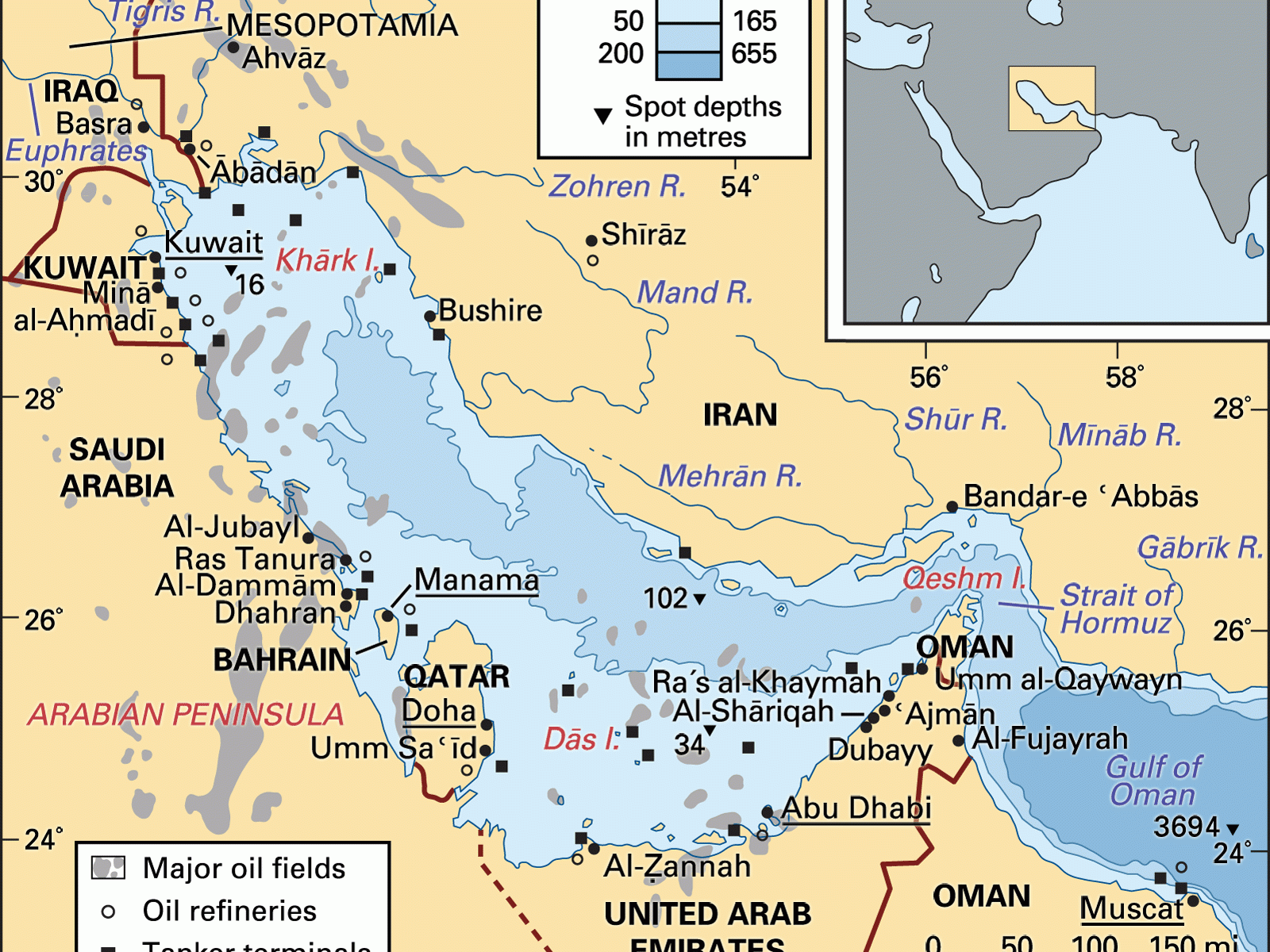

The delicate balance of powers between Saudi Arabia and Iran rest over the fulcrum of the Persian Gulf; an emblem of the division in each nations’ domestic ideology, and a divergence of their global agendas. Yet the gulf also denotes the concurrent mission of both nations: “pure, idealized states based on Islam,” (Glenn, C., WilsonCenter).
The best level of analysis to assess the foreign relations between Saudi Arabia and Iran is using State Level Analysis. While Saudi Arabia is endowed with a wealth of resources, its Iranian neighbor poses an immediate threat to its long-term domestic stability. A state level analysis shows that this concern stems primary from political, economic, social elements; with focus on long term national defense. The immediate threat to the safety of Saudi Arabian citizens, and their domestic resources would appeal to malevolent forces striving to overturn the incumbent regime.
Accordingly, a strong and resilient nation is more likely to be supported; despite its concerning behavior on the world stage of the international system. Thus, Mohammed bin Salman has sought to preserve the Saudi Arabian state, by deescalating its conflict with Iran—in order to preserve his incumbency, the favor of his powerful political allies, and the stability of the state. Using state level analysis, it is clear to see the increasing capacity of Saudi Arabian-Iranian relations; and its impact on the world stage.
A History of Conflict
Saudi Arabia’s crown prince, Mohammed bin Salman, responded to “anti-government protests demanding greater rights for the minority Muslim sect in the predominantly Sunni Muslim country,” (Batrawy, A.; NPR). As a result, mass executions were conducted, including Saudi Arabian Cleric Al-Nimr, “a widely revered Shiite Muslim cleric from eastern Saudi Arabia” who was convicted in Oct. 2014 of sedition and other charges and sentenced to death,” in Saudi Arabia, (GlobalNews). This instigated a civil conflict, whereby Iranian protesters in Tehran, to “[break] into the Saudi embassy” and set fires, (Batrawy, A.; NPR).
Seven years later, in June 2023, “Iran reopened its embassy in Saudi Arabia . . . marking another milestone toward restoring ties and lowering tensions” (Batrawy, A.; NPR). The best explanation of this can be found through state level analysis—Iran’s willingness to restore diplomacy with Saudi Arabia stems from its fear of “Iran’s nuclear program, as well as the reach of its drones and missiles that the U.S. said were behind a major attack on Saudi oil facilities in 2019,” (Batrawy, A.; NPR).
Simultaneously, “Iran’s embassy reopened the same day that U.S. Secretary of State Antony Blinken was scheduled to arrive in Saudi Arabia, where he has vowed to push for normalization with Israel,” (Batrawy, A.; NPR). Iran’s move displayed its concern for a favorable reputation on the world stage, despite its alarming domestic policy, continued nuclear research and development, and a lack of concern for basic human rights and ethnic minorities.
Saudi Arabia and Iran are “rival nations” who backed “opposing sides in civil wars in both Syria and Yemen,” (GlobalNews). Yet, state diplomatic relations have advanced despite the individual social conflict; “[d]espite the attack on the Abqaiq oil refining facility in Saudi Arabia in 2019, the tension between historic adversaries Saudi Arabia and Iran appears to have softened,” (Mingst & McKibben, p. 103).
The best explanation for this is both nations’ retention of authority through securing the state. Unlike Individual foreign policy analysis, focusing on the roles of individuals, State level analysis focuses on the interests of the state. A powerful state ensures the preservation of any foreign leader’s incumbency; lest their regime succumb to a drone strike, aerial attack, or other coup d’état.
Scripture warns against the threat of disunion produced by civil wars. The New Testament reminds us that “Jesus knew their thoughts and replied, ‘Any kingdom divided by civil war is doomed. A town or family splintered by feuding will fall apart,’” (Matthew 12:25 NLT). Therefore the looming threat of a covert civil war being launched from within Iran or Saudi Arabia’s own political state amassed a fear that resulted in an alliance, as dynamic as the tides of the Persian gulf that divides them.
Strong Bipolar Relations
Iran and Saudi Arabia share a bipolar system. Mingst and McKibben define Bipolar Systems as “those in which the distribution of the power to conquer is concentrated in two states or coalitions of states, (Mingst & McKibben, p. 106). But their relationship lack sufficiency under an international system. While, the New Testament calls for union, decreeing “[m]ay God, who gives this patience and encouragement, help you live in complete harmony with each other, as is fitting for followers of Christ Jesus,” (Romans 15:5; NLT); a union of faith in God does not explain the alliance of the competing Muslim factions.
Neorealist theorist Kenneth Waltz attests that “the bipolar international system is the most stable structure in the long run,” (Mingst & McKibben,p. 109). Additionally, many neorealists believe that “bipolar systems are likely to be more peaceful,” as they focus on direct relations without third-party intervention, (Mingst & McKibben, p. 109).
Iran and Saudi Arabia’s bipolar relationship is highlighted by revision of governance and leadership to comport with multi-lateral diplomacy. Iranian President Hassan Rouhani has begun to “[expand] Iran’s outreach to the world in the wake of the nuclear deal in July, provoking a backlash from hardliners seeking to preserve the revolutionary character of the state,” (Glenn, C., WilsonCenter). Whilst Saudi Arabia’s King Salman “removed his brother as his successor and replaced him with a younger prince,” (Glenn, C., WilsonCenter).
Both nation’s revisions attune to a state initiative to comply with a predetermined agenda, while strengthening the autonomy of the state through bilateral action. On one hand, Iranian officials seek to engage in diplomacy to appease Western powers. On the other hand, Iran’s nuclear weapons protect it from Western allied intervention. Saudi Arabian officials’ diplomacy is an assurance to their citizens that the potential for Iranian terrorism will be lessened.
A state level analysis shows that Iran is a member of over 50 international organizations, (CIA). But Iran opposes compliance with the international system, in fear of eroding its individual power; or worse, losing its qualifications as a state under international law. Diplomacy will ensure that Iranian leader Ali Khamenei retains his power amongst the fear of being overthrown by Western powers. On March 31st, 2025, Khamenei wrote on the X platform that, “[u]nity doesn’t imply that governments think alike in terms of all their political orientations. The unity of the Islamic world involves recognizing common interests and moving forward in that direction,” (X). Khamenei’s political declarations on the American social media platform reveal his need for Western powers. Khamenei’s simultaneous fear of, and need for, Western resources leave the nation in a willing position to merge forces with its surrounding neighbors. Khamenei’s mission is clear—protect the state at all costs. By protecting the state of Iran, Khamenei legitimizes his actions—subject to the scrutiny of the West for its unchecked nuclear potential.
Weak Multi-Polar Relations
But Iran’s nuclear stockpiling threatens the recognition of the Iranian state from the West. Mingst and McKibben note that “[u]nder international law, for an entity to officially qualify as a state, it must meet four fundamental legal conditions, as outlined in the 1933 Montevideo Convention,” (Mingst & McKibben, p. 119).
These four qualifications as held under international law include: first, (1) “a state must have a territorial base, with geographically defined boundaries;” second, (2) “a stable population must reside within its borders;” third, (3) “[the] population should owe allegiance to an effective government;” and fourth, (4) “other states must recognize the state diplomatically,” (Mingst & McKibben, p. 119).
In June 2023, former Secretary of State Antony Blinken announced that “’all options will be on the table’ to prevent Iran from obtaining a nuclear weapon,” (Batrawy, A.; NPR). The term “all options” includes deposing the Iranian regime under international law. Iran has, thus strived to avoid its complete reliance on the international system, despite its affiliation. Accordingly, “[p]erhaps no technological change has had a stronger impact on the international system than the development of nuclear weapons,” (Mingst & McKibben, p. 116).
Saudi Arabia’s prosperity is significant to the majority of the world; as “Saudi Arabia possesses around 17 per cent of the world’s proven petroleum reserves” in addition to “natural gas, iron ore, gold, and copper,” (OPEC). Saudi Arabia bestows its own sovereignty, capitalizing on its natural resources and international diplomacy.
Yet Saudi Arabia relies on the international system; declaring itself “deeply concerned about Iran’s nuclear program, as well as the reach of its drones and missiles that the U.S. said were behind a major attack on Saudi oil facilities in 2019,” (Batrawy, A.; NPR). Despite its concerns, Saudi Arabia continues to pursue civility with its Iranian neighbor.
Saudi Arabia has a population of 34.79 million, and is “the 14th largest country in the world,” and “the second largest OPEC Member Country,” (OPEC). From the ABEDA (Arab Bank for Economic Development in Africa) to the WTO (World Trade Organization), Saudi Arabia is a member of over 50 international organizations, (CIA). But the nations’ bilateral relations thwart the multipolar system’s delicate balance of powers.
Both Saudi Arabia and Iran’s national priorities overrule the multipolar system’s ‘implicit guides,’ like “rules of competition, cooperation, and shifting alliances,” (Mingst & McKibben, p. 106). Thus, the bipolar alliance forged between nations is a direct result of an assurance of the security of the state. Thus, a state level analysis provides the necessary information to understand the growing alliance, and the resulting effects on their international relationships and membership to foreign alliances.
Unilateral initiative through symbiotic bilateral international relations comport with Scripture in that The New Testament instructs us to “[l]et each of us please his neighbor for his good, to build him up” (Romans 15:2; ESV). Yet bipolar relations have significant impact on multilateral relations and the international system; “[b]ipolar systems are very difficult to regulate formally, because neither uncommitted states nor international organizations can reliably direct the behavior of either of the two poles,” (Mingst & McKibben, p. 109).
International and Individual Contention
Conversely, an International System Analysis falls short in explaining the conflict between Western powers and Iranian government. Secondly, it falls short alongside the negative impact of forming alliances with American rivals. Nor would it explain polarity, interdependence, or any collective.
On Human Rights, Iran’s “penal code permits traditional Islamic punishments, such as stoning, flogging, and amputation. Iran has the second-highest execution rate in the world, after China. Iran executed at least 289 people in 2014,” (Glenn, C., WilsonCenter). Thus, “[i]ndividual perceptions are often shaped in terms of mirror images,” (Mingst & McKibben, p. 130). Iran’s mirror imaging considers its own actions “good, moral, and just,” and Saudi Arabian and Western actions as “evil, immoral, and unjust,” (Mingst & McKibben, p. 130).
In comparison, Saudi Arabia’s judicial system uses cognitive consistency to “select or amplify information that supports existing beliefs and ignore or downplay contradictory information,” (Mingst & McKibben, p. 129). Cognitive consistency grants judges “unparalleled flexibility in judgments and punishments since the kingdom has no formal penal code and individuals have few specified rights,” (Glenn, C., WilsonCenter).
Beyond the “widely documented” government “violations of due process, arbitrary arrests, and torture . . . Saudi Arabia ranks third in executions – right below Iran – with 90 total executions carried out in 2014,” (Glenn, C., WilsonCenter). Therefore, an international system analysis is unfavorable in achieving a comprehensive understanding of the delicate balance of power shared by the Iranian and Saudi Arabian state.
Similarly, an Individual Analysis lacks an explanation of personability or a concurrence of individual national concerns. It is extremely unlikely that either leader feels compelled to better understand the individual nature of the opposing state, as they each hold directly conflicting ideologies. The Wilson Center’s Cameron Glenn writes that “Iran is a predominantly Shiite theocracy; Saudi Arabia is a predominantly Sunni monarchy,” (Glenn, C., WilsonCenter). Thus, these opposing identities cannot be the cause of the relations between Iran and Saudi Arabia.
The Middle East Institute writes that “[o]ne of the main differences is that the Saudi regime is not a theocratic regime like Iran, but rather a monarchy with a hybrid structure, neither wholly secular nor wholly religious,” (Alsaied, N., MEI). The MEI adds that “Saudi Arabia is a Muslim state, not an Islamist revolution” like Iran, (Alsaied, N., MEI). Therefore, “political systems can change . . . while ideological systems never do. On the contrary, they become more entrenched because change means the end of the system,” (Alsaied, N., MEI). An individual analysis lacks the totality of comprehension required to fully grasp the relationship between Saudi Arabia and Iran.
Conclusion
The impossibility of Iran and Saudi Arabia’s diplomacy is supported by their locality, history, and concurrent hierarchy of national interests. While both nations hold different beliefs about religious tolerance, they can agree on the preservation of their incumbency, through the union of their powers.
Both nations seek to preclude the encroachment of Western hegemony. Both leaders believe in some form of ethnic cleansing to strengthen national resilience. Both states place their nation’s own priorities above their own agendas, in an effort to thwart political dissent. Thus, an alliance of security ensures a resilient and sovereign state, immune from the spotlight on the world stage, and from the collective expectations of the international majority.
Bibliography
Alsaied, N., MEI. (Accessed on April 6th, 2025). Sectarianism and ideology: The cases of Iran and Saudi Arabia. https://www.mei.edu/publications/sectarianism-and-ideology-cases-iran-and-saudi-arabia
Batrawy, A., GlobalNews. (Accessed on April 6th, 2025). Who Was Shiite Cleric Nimr Al-Nimr, And Why Did Saudi Arabia Execute Him? – National. Globalnews.ca. https://globalnews.ca/news/2431495/who-was-shiite-cleric-nimr-al-nimr-and-why-did-saudi-arabia-execute-him/
Batrawy, A., NPR. (Accessed on April 6th, 2025). Iran Embassy Reopens In Saudi Arabia : NPR. https://www.npr.org/2023/06/06/1180157114/iran-reopens-embassy-in-saudi-arabia
CIA. (Accessed on April 6th, 2025). Iran – The World Factbook. https://www.cia.gov/the-world-factbook/about/archives/2023/countries/iran/
CIA. (Accessed on April 6th, 2025). Saudi Arabia – The World Factbook. https://www.cia.gov/the-world-factbook/about/archives/2023/countries/saudi-arabia/
ESV. Romans 15:2
Glenn, C., WilsonCenter. (Accessed on April 6th, 2025). Part 1- Iran v. Saudi Arabia: Islam’s Arch Rivals. https://www.wilsoncenter.org/article/part-1-iran-v-saudi-arabia-islams-arch-rivals
Mingst, K. A., McKibben, H. E. (2021). Essentials of International Relations, 9th Edition. [VitalSource Bookshelf 10.3.1]. Retrieved from vbk://9780393872033
NLT. Matthew 12:25
NLT. Romans 15:5
OPEC. (Accessed on April 6th, 2025). Saudi Arabia. https://www.opec.org/saudi-arabia.html
X. (Accessed on April 6th, 2025). Khamenei_IR. https://x.com/khamenei_ir
 Jordan Muhsin