
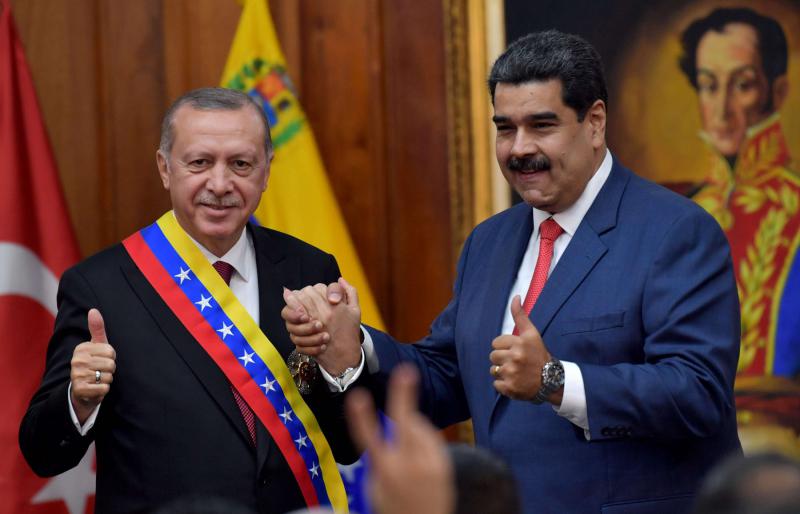

The framework of neorealism is the best explanation for Turkey’s unlikely relationship with Venezuela, revealing the tendency of nations to partner, despite lacking any cultural or historical connection. Like Venezuelan president Nicolas Maduro, Turkish president Recep Tayyip Erdoğan believes that his nation’s approach is sound, provided its cooperative compliance results in the attainment of self-interests, and assurance of national security. Neorealism relies on taking necessary steps to increasing national defense, no matter the execution of conduct used to attain objectives. Conversely, liberalist foreign policy relies on strenghth in numbers, thereby remaining tethered to an illusory “inherent goodness” of man. In Turkey’s case, it is partnering with concerning foreign leaders to ensure its own independence, rather than the belief that Maduro is ‘inherently good natured.’ Neorealism presupposes the inherent malevolence of man—contingent on the domestic incapacitation and international deterrence of political opposition through national security.
Like Thomas Hobbes, Venezuela and Turkey’s government believe each party must cooperate to ensure its sustainability and prosperity. Thomas Hobbes believed that “relations among sovereign states,” would take a realist approach; establishing “a condition of anarchy where the norm for states is ‘having their weapons pointing, and their eyes fixed on one another.’” Turkey and Venezuela believe similar to Hobbes that “few rules or norms can restrain states. War—defined by Hobbes as a climate in which peace cannot be guaranteed—would be perpetual,” (Mingst & McKibbens, p. 71).
Turkey’s Coup d’état On July 15, 2016, third party operatives launched a coup d’état against the Turkish government in an effort to abdicate Turkish president Recep Tayyip Erdoğan, (WilsonCenter). Erdoğan called the citizens of the nation to preserve his power, supported the loyalty of his military. But Turkey’s international image has remained heavily impacted. Erdoğan despotically “purge[d] thousands of military and government officials he suspected of plotting against him. More than two hundred media outlets were closed, and dozens of journalists were jailed on dubious charges,” (WilsonCenter).
Erdoğan believed that the Fethullah Gulen, a “transnational religious and social movement,” was responsible for the failed coup attempt. In response, Erdoğan designated followers of the pluralistic form of Islam, as “domestic terrorists,” (CIA).
Worse, “Gulen’s residence in Pennsylvania was seen as clear evidence of U.S. involvement in the coup plot,” (WilsonCenter). Turkish President Erdoğan asked “Washington to extradite Gulen on the charge of masterminding the coup attempt,” but has been rejected. Thus, a pervasive “[a]nti-Americanism has dramatically increased in the wake of the failed coup,” (WilsonCenter).
Erdoğan’s purge of his political opposition replicated the actions of a dictatorship, imposing hesitancy for Western involvement. Instead, it attracted the interests of foreign dictatorships, like Venezuelan president Nicolas Maduro, (WilsonCenter). The Central Intelligence Agency (CIA) notes that Venezuelan president Nicolas Maduro is seen as illegitimate, as he attained power through suspected fraudulent elections, (CIA). Thus, “Turkey’s desire to develop a relationship with Venezuela as part of a policy to deepen its relations with Latin America,” (WilsonCenter).
Turkey seeks its own sovereignty in an anarchic system draws question to the sincerity of its allegiance to collective neoliberal institutions. The less dependent Erdoğan becomes on the global international system, the more assurance he gains to remain in power. Turkey’s sovereignty imparts less reliance on NATO, the UN and other neoliberal institutions by trading domestic products for Venezuelan resources. Erdoğan believes his ability to improve Turkey’s economy will increase the nation’s national security—whilst preserving his incumbency.
Furthering their autonomous relations, in October 2016, Maduro “announced his first trip to Turkey,” attending “the World Energy Congress in Istanbul,” (WilsonCenter). There, Maduro and Erdoğan “signed a series of bilateral agreements on energy, trade, and air transportation,” thereby forging their own alliance, (WilsonCenter). Maduro’s gesture was returned in 2018 when “Turkish president Erdoğan visited Venezuela,” to conduct further business.
Thus, Venezuela and Turkey, share “an alliance of convenience” alongside the “mutual dislike of the United States and closer relations with Russia;” allowing for international engagement in “bilateral trade,” (WilsonCenter). Turkish President Erdoğan abolished all domestic dissent, while simultaneously partnering with Maduro. Thus, the two nations “[developed] a relationship marked by mutual economic benefit at a time when both countries have sought to find alternative commercial partners,” (WilsonCenter).
David A. Baldwin writes that “international anarchy may lead states to be concerned about gaps in gains from cooperation not just because they seek security and survival, but also because they value their independence,” (Baldwin, D., p. 315). Therefore, “[t]his need for self-help sufficiency leads states to value autonomy and independence,” (Baldwin, D., p. 315). Robert O. Keohane writes that “[a] self-help system is one in which those who do not help themselves, or who do so less effectively than others, will fail to prosper, will lay themselves open to dangers, will suffer,” (Keohane, R., p. 117). Keohane adds, “the system won’t work at all if states lose interest in preserving themselves,” lest losing their political identities to “amalgamation,” (Keohane, R., pp. 117, 118).
The Observatory of Economic Complexity cites that “[i]n 2023, Turkey exported $366M to Venezuela. The main products exported from Turkey to Venezuela were Pasta ($91.4M), Wheat Flours ($89M), and Refined Petroleum ($32.7M),” (OEC). Moreover, [i]n 2018, Venezuela exported $364M to Turkey. The main products exported from Venezuela to Turkey were Scrap Iron ($272M), Nitrogenous Fertilizers ($27.5M), and Petroleum Coke ($16.8M), (OEC). This means that Turkey is the main economic trade partner of Venezuela; “[i]n 2023, countries that imported more from Venezuela than Turkey included Dominica ($10.5M),” (OEC).
Realism vs Neoliberalism Realism comports with Christianity in its aspiration to walk humbly, and keep focus on the cross, whilst seeking strength in God (Ephesians 6:11–13) to overcome the natural tendency to engage in international war. As the Apostle Paul “and to aspire to live quietly, and to mind your own affairs, and to work with your hands, as we instructed you, so that you may walk properly before outsiders and be dependent on no one,” 1 Thessalonians 4:11-12 (ESV). Thus, any nation’s independence requires faith in God to provide, (Ephesians 3:20).
Trump is observably realist in his foreign policy approach whereas Erdoğan and Maduro are neorealist. The difference lies in their inherent worldview: Trump presupposes the propensity of man’s fallen state, taking necessary steps to increase national defense. Erdoğan presupposes an anarchic international system that he bases his international relations. Erdoğan’s neorealism operates under the pretext of neoliberal institutionalism.
Turkey is a member of NATO, the WHO, the World Trade Organization (WTO), the UN, among other global agencies, (State). A neorealist disguised as a neoliberal can usurp greater autocracy over his own dictatorship. International Relations professors Barry Buzan, Charles Jones, and Richard Little write that, “Neorealists argue that imperialism, is a universal phenomenon and . . . a general theory of international politics;” further, “Neorealists assume that all empires take the same structural form,” (Buzan, B.; Jones, C.; Little, R., p. 91).
Authors Mingst and McKibben write that “[w]hile traditional realists attach importance to the characteristics of states and human nature, neorealists give precedence in their analyses to the structure of the international system as an explanatory factor,” (Mingst & McKibben, p. 75).
Unlike Erdoğan and Maduro’s persistent fears of deposition, neoliberals believe that conflict can be avoided. Authors Mingst and McKibben write that “[l]iberals believe that injustice, war, and aggression are not inevitable but can be moderated or even eliminated through institutional reform or collective action,” (Mingst & McKibben, p. 81).
In contrast, under the framework of realism, international political opposition must be handled assertively; resulting in a pluralistic, anarchic international system. Realists are reluctant to acquiesce to foreign alliances, instead examining their own national interests, without compromise. Realists act through persuasion, unlike neorealists institutionalists are coerced by the threat of war, instead providing an umbrella of lasting peace through foreign alliance. Realists are persuaded by the perpetual threat of war, and in turn align with nations who can trade resources. The elevation of resources contributes to their sovereignty, precluding dependency on institutional collectivists.
Erdoğan’s Neorealism On September 4th, 2016, neorealist Turkish President Erdoğan met with neoliberal institutionalist Former President Barack Obama in a bilateral meeting. Here, Erdoğan’s inherent neorealism forced his acquesing to Obama’s neoliberal institutionalist approach to foreign policy; imposing the doctrine of complex interdependence to attain “anarchy abridged”, (Mingst & McKibben, p. 80). Obama declared to Erdoğan that “with you, under your leadership, the alliance between our countries became a model partnership,” (WhiteHouse). Erdoğan responded that “Turkey and the United States have been a strategic partner and a very close ally,” (WhiteHouse). But Erdogan was still willing to test the strength of his international alliances—including his partnership with the U.S. and NATO—to forge an independent trade agreement with Maduro.
Unlike the neoliberal, neorealists foresee the potential malevolence of nations; “the state that gains more relative to the other has a security advantage, and the one that gains less becomes more insecure and susceptible to attack,” (Mingst & McKibbens, p. 72).
In 2019 Erdoğan held another bilateral meeting with America’s president. Erdoğan spoke to U.S. president Donald Trump—a foreign policy realist. Erdoğan dictated U.S. foreign policy to Trump, warning that Muhammed Fethullah Gülen should not be considered as an interlocutor with the United States. Displaying realism, Erdoğan disregarded his international commitments, demanding that America designate his political opponents as terrorists. Erdoğan warned that “’[i]t happens to us today and it will happen to somebody else tomorrow’ is a saying that goes in our language,” (WhiteHouse). The Turkish president issued a second warning, to Trump that “[i]f you don’t fight back, then tomorrow you will have to pay a very hefty price,” (WhiteHouse). All of Erdoğan’s grotesque warnings indicates his fear of perpetual war and inevitable deposition.
Erdoğan observably is only concerned with the security of his own authority. While Erdoğan relies on the international support by his membership to NATO, he relies on the anarchic system to decrease institutional dependence. Neoliberals, similar to realists, believe “states are key unitary actors in international politics that rationally pursue their own self-interest in an anarchic international system,” (Mingst & McKibben, p. 80). While neoliberals believe “states can cooperate;” unlike realism, “there is not a hierarchy of issues;” thus, “[s]tates are concerned not only about security but also about other issues on which they share common interests,” (Mingst & McKibben, p. 80). Erdoğan makes it clear that his self-interest is to Turkey and his own incumbency. Maduro gains vicarious trade with NATO, as Turkey is now free to siphon weapons, resources, and money to the dictatorship.
Like Erdoğan, “states’ actions represent some subset of . . . individuals and private groups;” and “state behavior is defined by the configuration of state preferences, rather than the configuration of state power,” (Mingst & McKibben, p. 81). Thus, “[w]hen states’ underlying preferences are compatible, cooperation is likely to result,” (Mingst & McKibben, p. 81). As with Venezuela, “the more power you have, the more power you get;” through “intimidating potential rivals into cooperation,” (Mingst & McKibben, p. 74).
Despite their differences, Erdoğan believes Venezuela’s partnership to be essential; yet he designates opposition to his presidency domestically or from surrounding nations, as terrorists. When Erdoğan publicly defined the term terrorists, he specified “terrorists don’t have an ethnicity, they don’t have a nationality, they don’t have a flag. If they’re terrorists, that is a terrorist,” (WhiteHouse). Erdoğan’s paranoia reveals he believes the international system is anarchic, and he is faced with the constant threat of war—both foreign and internally.
The Detriment of Turkey’s Realism
Turkey is faced with a Security Dilemma, producing “a permanent condition of tension and power conflicts among states, even if none actually seek conquest and war,” (Mingst & McKibben, p. 72). Concisely, “[a] gain in security for one state is a loss for the other,” (Mingst & McKibben, p. 72). On Venezuela, the U.S. Department of State’s Bureau of Consular Affairs warns “[a]void travel to Venezuela via any means, including via land border crossings . . . [e]ntering or attempting to enter . . . can lead to indefinite detention without consular access,” (Travel).
Like Venezuela, Turkey’s solution was to become a unitary state that persecutes political opposition and citizens for their faith. One of Erdoğan’s targets during the political purge following the 2015 coup was American Pastor Andrew Brunson—an evangelical church planter born in North Carolina, on mission in Turkey since 1993—who was falsely accused and convicted of terrorism, (VOM).
Obama, a neoliberal institutionalist, ignored this discrepancy, overlooking the false imprisonment of an American citizen. Obama never acknowledged detained American Pastor Andrew Brunson.
When President Donald Trump entered office, he promptly returned the American evangelical from Turkish prison, following his conviction. After two years of imprisonment and isolation, the Trump administration finally “imposed sanctions on Turkey in 2018 over the arbitrary detention of American pastor Andrew Brunson,” (WilsonCenter).
Erdoğan’s neorealist reactionary response to Donald Trump’s realism, led him to release the wrongly incarcerated American. Pastor Brunson stated that he relied on Isaiah 50:10 everyday whilst imprisoned; “[w]ho among you fears the LORD and obeys the voice of his servant? Let him who walks in darkness and has no light trust in the name of the LORD and rely on his God,” (Isaiah 50:10; ESV).
Pastor Brunson’s testimony reinforces Turkey’s state of neorealism—that the state is sustained through autonomous action, and the attainment of resources. Therefore, Realism is the primary explanation of Venezuela and Turkey’s unconventional relationship. Unlike neoliberal institutionalists who believe that “states are rational” and that “self-interest managed by structure (institutions) leads to [the] possibility of cooperation and peace;” Erdoğan does not foresee the de-escalation of domestic conflict without the incapacitation of political opposition, (Mingst & McKibben, p. 79).
Turkey’s foreign policy remains synthetically curated to depict a strongly democratic government. Turkey’s Republic of Türkiye Directorate of Communications Center for Countering Disinformation proclaims after every public post on their social media platforms that “[u]nfounded claims aimed at manipulating international public opinion should not be given credit,” (X). Turkey’s propaganda technique is one described by the CIA as ‘frequent phrasing,’ (CIA). On propaganda, the CIA confirms that “[t]he most important thing to remember when speaking to a large crowd is to have a firm hold on the people and to keep them in order,” (CIA).
Conclusion
While the alliance between Turkey and Venezuela is explicitly for trade, it bolsters their national independence; simultaneously increasing the security of each state. But similar to Thomas Hobbes, Venezuela and Turkey believe that without the state man is animalistically anarchic. Thus, both leaders have invoked Hobbesian doctrine to form a Leviathan and thwart dissent. Peace is not guaranteed, but domestic security is achieved by reduced dependency and the negation of deference to a higher authority.
Bibliography
Archives. (Accessed on March 26th, 2025). Remarks by President Obama and President Erdogan of Turkey After Bilateral Meeting at G20 Summit. whitehouse.gov. https://obamawhitehouse.archives.gov/the-press-office/2016/09/04/remarks-president-obama-and-president-erdogan-turkey-after-bilateral.
Archives. (Accessed on March 26th, 2025). Remarks by President Trump and President Erdoğan of Turkey in Joint Press Conference. The White House. https://trumpwhitehouse.archives.gov/briefings-statements/remarks-president-trump-president-erdogan-turkey-joint-press-conference/
Baldwin, D.A. (1993). Neorealism and Neoliberalism: The Contemporary Debate. Columbia University Press: New York.
Buzan, B.; Jones, C.; Little, R. (1993). The Logic of Anarchy: Neorealism to Structural Realism. Columbia University Press: New York.
CIA. (Accessed on March 26th, 2025). Guide to Propaganda. https://www.cia.gov/readingroom/docs/CIA-RDP81-01043R002300230001-6.pdf
CIA. (Accessed on March 26th,2025). The World Factbook: Turkey. https://www.cia.gov/the-world-factbook/about/archives/2023/countries/turkey-turkiye/
CIA. (Accessed on March 26th, 2025). The World Factbook: Venezuela. https://www.cia.gov/the-world-factbook/countries/venezuela/
Keohane, R.O. (1986). Neorealism and its Critics. Columbia University Press: New York.
State. (Accessed on March 27th, 2025). U.S. Relations With Turkey. https://www.state.gov/u-s-relations-with-turkey/#:~:text=Turkey%20is%20a%20member%20of,Euro%2DAtlantic%20Partnership%20Council%2C%20the
Mingst, K. A., McKibben, H. E. (2021-12-15). Essentials of International Relations, 9th Edition. [VitalSource Bookshelf 10.3.1]. Retrieved from vbk://9780393872033
Travel. (Accessed on March 27th, 2025). Travel Advisories: Venezuela. https://travel.state.gov/content/travel/en/traveladvisories/traveladvisories/venezuela-travel-advisory.html#:~:text=Avoid%20travel%20to%20Venezuela%20via,indefinite%20detention%20without%20consular%20access
VOM. (Accessed on March 27th, 2025). God’s Hostage. https://vom.com.au/product/gods-hostage/
WilsonCenter. (Accessed on March 26th, 2025). Turkey and Venezuela: An Alliance of Convenience. https://www.wilsoncenter.org/sites/default/files/media/uploads/documents/LAP_200317_ven%20turkey_v2%20%281%29.pdf
X.(Accessed on March 26th, 2025). Republic of Türkiye Directorate of Communications. https://x.com/communications
YouTube. (Accessed on March 26th, 2025). Pastor Andrew Brunson: Two Years in a Turkish Prison. https://www.y outube.com/watch?v=ENiAykIiono&ab_channel=VoiceoftheMartyrsAustralia
 Jordan Muhsin