
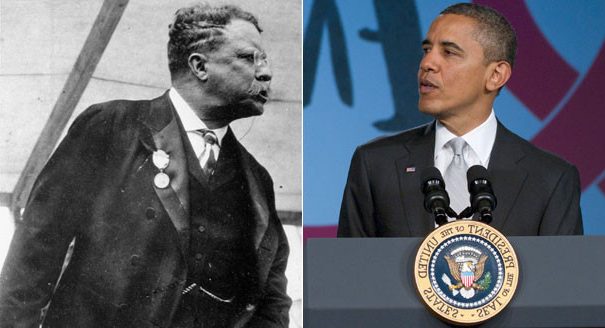

In drawing comparisons and contrasting two U.S. presidential foreign policy speeches— Theodore Roosevelt’s (1858–1919, in office 1901–1909) Corollary to the Monroe Doctrine of 1905 and Barack Hussein Obama II’s (in office 2009–2017) Remarks by the President in Address to the Nation on Libya on March 28th, 2011—it is clear that contemporary American Foreign Policy has drifted to a point that is almost unrecognizable from its Founding Fathers. From rhetoric to union, both Roosevelt and Obama shared concurrent concerns. Yet in execution and diplomacy, the two presidential actions bear significant differences.
Theodore “T.R.” Roosevelt’s Corollary to the Monroe Doctrine was distinguished by his use of foreign policy in a defensive manner. Barack Hussein Obama’s Remarks by the President in Address to the Nation on Libya was marked by his use of foreign policy offensively, under the pretext of foreign alliance. Roosevelt’s speech designated America’s boundaries, formally enforcing the meaning of no trespassing. Obama’s speech was meant to enact fear in others foreign leaders, revealing the consequences for diplomatic disagreement against NATO’s agenda.
Theodore “Teddy” Roosevelt and Barack Obama were both charismatic in the delivery of their presidential foreign policy speeches.
Theodore Roosevelt, speaking on morality and national obligation, stated that while, “[i]t is our duty to remember that a nation has no more right to do injustice to another nation, strong or weak, than an individual has to do injustice to another individual; that the same moral law applies in one case as in the other;” (Archives). Roosevelt recognized God’s inherent natural law of individual sovereignty possessed by every nation; warning, “[b]ut we must also remember that it is as much the duty of the Nation to guard its own rights and its own interests as it is the duty of the individual so to do,” (Archives).
Similarities
Similar to Obama’s rhetoric, Roosevelt acknowledged that “[i]f a nation shows that it knows how to act with reasonable efficiency and decency in social and political matters, if it keeps order and pays its obligations, it need fear no interference from the United States.”
Like Obama, Roosevelt cited “[c]hronic wrongdoing, or an impotence which results in a general loosening of the ties of civilized society, may in America, as elsewhere, ultimately require intervention by some civilized nation,” (Archives).
Also like Obama, Roosevelt knew that the actions of other nations bore a direct impact on American posterity. Similarly, Theodore Roosevelt believed that “[n]evertheless there are occasional crimes committed on so vast a scale and of such peculiar horror as to make us doubt whether it is not our manifest duty to endeavor at least to show our disapproval of the deed and our sympathy with those who have suffered by it,” (Archives).
Like Roosevelt’s Corollary, Obama believed in diplomacy over mobilization. Obama stated that “we’ve accomplished these objectives consistent with the pledge that I made to the American people at the outset of our military operations,” (Archives).
Obama reminded the public that “I said that America’s role would be limited; that we would not put ground troops into Libya; that we would focus our unique capabilities on the front end of the operation and that we would transfer responsibility to our allies and partners. Tonight, we are fulfilling that pledge,” (Archives).
Differences
Differentially, Roosevelt defended America’s proximity, whereas Obama sought to defend American ideology. Obama did not unionize Americans with his rhetoric in the same manner as Roosevelt. Teddy Roosevelt expanded America’s boundaries to strengthen U.S. national security, and preclude foreign nations from influencing America’s allies to become political rivals. Rather than form alliances, Roosevelt would obligate himself and the nation to significant changes in physical proximity of its jurisdiction. By contrast, Obama addressed the nation to explain unconventional actions that had occurred on behalf of a foreign alliance, and the threat to its ideology. Moreover, Obama placed America’s interests beneath the global new world order he sought to invest America in. But global new world order was exactly what Roosevelt was attempting to preclude by the expansion of U.S. territory.
Roosevelt perceived foreign policy as realism through his Christian worldview, whereas Obama’s neoliberal vision formed his foreign policymaking decisions. Geopolitical analyst Kenneth Waltz wrote in 1954 that “[i]t is not only that a state, becoming too fond of peace, may thereby perish; but also that the seeming somnolence of one state may invite a war of aggression that a more aggressive pose by the peace-loving state might have avoided altogether,” (Waltz, K., p. 221).
Roosevelt was clear in his Corollary to the Monroe Doctrine in 1905 that “in the Western Hemisphere the adherence of the United States to the Monroe Doctrine may force the United States, however reluctantly, in flagrant cases of such wrongdoing or impotence, to the exercise of an international police power,” (Archives). Roosevelt did not need to invest himself, nor the nation into foreign alliance to ensure national security; thereby proving that America would enter the 20th Century carrying the same weight of liberty and independence it had spent the previous century fighting for. Unlike Teddy Roosevelt, Obama did not carry a big stick in his application of U.S. foreign policy. Obama sought to forge global alliances to strengthen America’s national defenses. Obama relied on “the international community” to support his decision-making, rather than the American people.
Unlike Obama, Roosevelt did not seek to invest the nation into foreign alliances. Roosevelt stated that “[a]ll that this country desires is to see the neighboring countries stable, orderly, and prosperous. Any country whose people conduct themselves well can count upon our hearty friendship,” (Archives).
Converse to T.R., Obama acted in the best interests of a foreign alliance, where he used national resources to pledge his allegiance to NATO’s agenda. Obama noted that “[t]en days ago, having tried to end the violence without using force, the international community offered Qaddafi a final chance to stop his campaign of killing, or face the consequences,” (Archives).
Differentially, Roosevelt held that “[o]rdinarily it is very much wiser and more useful for us to concern ourselves with striving for our own moral and material betterment here at home than to concern ourselves with trying to better the condition of things in other nations,” (Archives). Roosevelt’s expansion of the Monroe doctrine was a necessary executive action to bolster America’s national defense.
Unlike Obama, Teddy believed that domestic change would produce greater benefit than the foreign convergence of nations. It is extremely unlikely that Teddy Roosevelt would have resorted to drone striking a foreign leader, no matter his partisanship. Roosevelt spoke that “under ordinary circumstances we can do more for the general uplifting of humanity by striving with heart and soul to put a stop to civic corruption, to brutal lawlessness and violent race prejudices here at home than by passing resolutions and wrongdoing elsewhere,” (Archives). Thus, Roosevelt concluded “[w]e have plenty of sins of our own to war against,” (Archives). To Roosevelt, engagement in foreign war over ideology was not an option.
Conversely, to T. Roosevelt, Obama speaking on the claimed atrocities of the Libyan government, that “[i]t was not in our national interest to let that happen. I refused to let that happen. And so nine days ago, after consulting the bipartisan leadership of Congress, I authorized military action to stop the killing and enforce U.N. Security Council Resolution 1973,” (Archives). While Teddy’s rhetoric depicted his strength through righteous power and executive stewardship, Obama’s actions revealed his fear of isolationism and his obligation to foreign alliances.
Dissimilar to Obama’s remarks, Roosevelt’s speech empowered citizens to unite, and embrace the expansion of securing America’s borders; whereas Obama’s speech incited fear and promoted a state of civic division, both domestically and internationally. Obama’s rhetoric imposed a detrimental image for America, one that has remained since his incumbency. Rather than concerning his rhetoric with national union, he sought to invest America’s exceptional Republicanism abroad. By doing this, Obama weaken the international image of America, but deferred America’s U.S. foreign policy to an international alliance; a trend that continues to plague the executive branch.
Inconsistencies
Unlike Roosevelt’s neutral position on foreign intervention and his aversion toward forming global alliances, Obama’s wars were proxied from Washington. The false dichotomy of ‘global compliance or the mobilization of U.S. troops’ used by Obama has become favored in subsequent presidents who conduct war from the Oval Office. The practice of coercion is inconsistent with the Founding Fathers’ principles conducive with a Constitutional Republic.
Any neighboring country that aligned with American values were adopted in Roosevelt’s territorial expansion; whereas Obama sought to assassinate a foreign leader to further the expansion of democracy. Obama’s continued use of autonomous military force remains inconsistent with the Founding Fathers’ principles and Roosevelt’s defensive diplomacy.
Roosevelt’s rhetoric is a direct inversion of Obama’s worldview. Roosevelt treated his podium as the pulpit, proclaiming that “[t]here must be no effort made to remove the mote from our brother’s eye if we refuse to remove the beam from our own. But in extreme cases action may be justifiable and proper,” (Archives). Roosevelt’s words comport not only with Washington’s precedent of non-interventionism but are Biblically sound. Similarly, Jesus asks us in Scripture “[w]hy do you see the speck that is in your brother’s eye, but do not notice the log that is in your own eye?” (Matthew 7:3; ESV). Similarly, “’[d]o not judge, or you too will be judged. For in the same way you judge others, you will be judged, and with the measure you use, it will be measured to you,” (Matthew 7:1-2; NIV). T. Roosevelt made it clear that non-interventionism needn’t include foreign compliance.
By contrast, Obama’s references to his creator were procedural, stating “Thank you. God bless you, and may God bless the United States of America. Thank you.” Obama’s rhetorical use of God as a formal closing to his speech equivocates its meaning, simultaneously synthesizing an impression of faith in the eyes of believers, and a figure of speech to the secular. By contrast Roosevelt did not close his speech with God, evidencing his actions were motivated by his personal faith, rather than a curated impression by expectation. Roosevelt placed God in unsuspecting places and used Scriptural parables to entwine his views into his application of foreign policy, rather than solely using God as a valediction.
Obama called for faith in ideology; declaring that “[u]ltimately, it is that faith—those ideals—that are the true measure of American leadership,” (Archives). Obama did not state “it is faith” but specifically noted it was “that faith,” even clarifying his use of the word “that” to mean “those ideals.” But faith is contingent on Christ; Scripture is not an ideal. Jack C. Plano and Milton Greenberg define the term Ideology as “[t]he way of life of a people reflected in their political system, economic order, social goals, and moral values,” (Plano & Greenberg, p. 12). Moreover, that “[i]deology is particularly concerned with the form and role of government and the nature of a state’s economic system” (Plano & Greenberg, p. 12). Roosevelt aptly navigated this controversial terrain, writing, of America that “[o]ur interests and those of our southern neighbors are in reality identical,” (Archives). His reverence to sovereignty of nations allowed the expansion of America’s borders whilst preserving the tradition and cultures of surrounding countries. But most importantly, Roosevelt did not accede to the faith of foreign alliances, nor any ideology. Instead, Roosevelt preserved the Founder’s image of the Republic and strengthened U.S. national security without the use of force. The biggest inconsistency between these two presidential speeches is the dependence of foreign alliances, and the lack of civic representation.
Conclusion
The comparisons between Theodore Roosevelt’s and Barack Obama’s U.S. foreign policy speeches are significant. Both Roosevelt and Obama held reverence for their position as president, and respect for human dignity. But the difference was the specificity and proximity in each of their executive actions. The difference was in union—Roosevelt’s was the American people, whereas Obama’s was the international alliance. The difference was in subjugation—Roosevelt’s to God, and Obama’s to NATO. Unlike Obama, the Framers did not derive their faith from any foreign alliance.
Although Washington warned us against foreign alliances and unnecessary entanglement, he did not advocate for a nation of passivity. Theodore Roosevelt preserved this and the Framers’ precedent; that the United States of America was, like other nations, autonomous in its own right; as was it equal in its responsibility. America’s stance of foreign policy is non-interventionist, whilst assuring the national security of its citizenry.
Bibliography
Archives. (Accessed on March 21st,2025). Theodore Roosevelt’s Corollary to the Monroe Doctrine (1905) | National Archives. https://www.archives.gov/milestone-documents/roosevelt-corollary
Archives. (Accessed on March 21st, 2025). Remarks by the President in Address to the Nation on Libya | whitehouse.gov. https://obamawhitehouse.archives.gov/the-press-office/2011/03/28/remarks-president-address-nation-libya
Plano, J.C. et al. (1962, 1985). The American Political Dictionary, Seventh Edition. CBS College Publishing; Holt, Rinehart and Winston; The Dryden Press; Saunders College Publishing; New York, NY, 10017
Waltz, K. (1954). Man, the State, and War: A Theoretical Analysis. Columbia University Press.
 Jordan Muhsin