
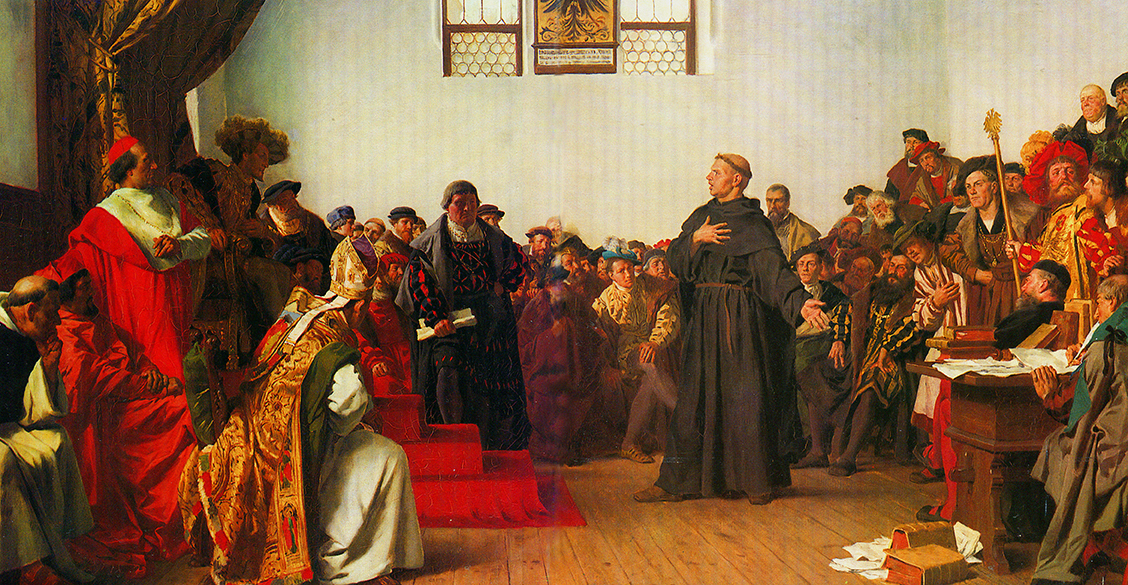

The Reformed Body Politic transfigured politics through the use of covenants, rejecting the primary doctrine of the Mediæval Body Politic as developed by early church fathers Augustine of Hippo and Thomas Aquinas. Yet the Reformation preserved one important attribute to the Mediæval Body Politic; divine order. The Reformation dissented against the hegemony of the principal body of the Christian Church, instead striving to revise the apostasy of the Roman Catholic Church. The Reformed Body Politic focused on personal covenant with God’s authority, rather than obtaining that authority through contract by the church. The Reformation asserted that the body of believers was the church; propounding the God-given right to individual sovereignty. Historian Glenn A. Moots reveals that, “[c]ovenants were among the very first symbols and devices to be used in ancient politics, and they remain with us in various forms today.” Moots suggests looking to Christian theologians before philosophers, as the Christian doctrine relies on moral objective truth. Historian Alan Ryan reports “The political consequences were described in Tocqueville’s Ancien régime et la révolution: many aristocrats and intellectuals despised superstition; they were genuine skeptics, and their skepticism inspired the radicals who hated the church because it was rich,” (Ryan, A., p. 981).
John Calvin remains a controversial figure in politics; critics accuse him of tyrannizing God, condemning the secular, and advocating a totalitarian state of theocracy; yet, Calvinist supporters declare him the greatest influence on Western democratic thought. Historian Sam Waldron writes that “Calvin was not even a citizen of the city he supposedly ‘tyrannized’ until 1559,” adding that he rejects that hierocratic interpretation of Calvin; Waldron instead asserts Calvin to be “the father of American Democracy,” (Waldron, S., pp. 19-20). Historian Alan Ryan writes, “Calvin’s discussion of the two kingdoms to which we owe allegiance does not imply the separation of church and state…The church must have its mode of worship fixed by the state, individuals must be compelled to attend services, and the pastors of the church must judge the citizens’ morals,” (Ryan, A., p.345).
On Calvinist Geneva, historian Sam Waldron writes that “from 1536 to 1541 Geneva was governed by a regime [caesaropapism] in which the State claimed to direct both the religious and the civil life of the citizens,” (Waldron, S., p. 18). Waldron adds there is a vast misconception “[f]rom 1541 onwards…[of] an actual power of Church over State which never existed…[but] from 1555 onwards…one can speak of an actual ascendancy of Calvin over the magistrates…this purely spiritual ascendancy never constituted authority in the juridical sense of the term,” (Waldron, S., pp. 18-19). Although Calvin was not a politician, nor ruler of government, his writings and position of thought continue to influence political scholars and contemporary jurists. Public legislation requires an objective reference in order to discern good from evil, and this is something that John Calvin and the Calvinist movement contributed to the Reformation, and the Reformed Body Politic, going on to influence modern politics. Government cannot dictate the ordinance of man, especially if that regulation defies Biblical doctrine, no matter the artificial pseudo-authority. Unlike the Mediæval Body Politic, the Reformed Body Politic rejected authoritarianism; but did not provide the means to allow a diverse body of constituents, weakening its polity.
Martin Luther was an authoritative influence of the Reformed Body Politic; composing 95 theses against the heresies of the Roman Catholic Church’s doctrine, among other writings. On the Classical Body Politic, Luther believed that Plato was greatly aware of God’s order, writing “[i]t is said of Plato, the philosopher, that he also was accustomed to give thanks to God for three things; first, that he was born a man and not a beast; secondly, that he was born a Greek at Athens, and not a barbarian; and thirdly, that he was born a man and not a woman. The fatuity of the Jews is just like this. They glory that they were born men, and not beasts; Jews, and not Gentiles; males, and not females. But to what, I pray you, does all this glory of origin amount?”
On politics, Martin Luther sought truth over tradition reporting “Plato is a friend; Socrates is a friend; but Truth is to be honoured above all,” (Luther, M., p. 1216). Historian Eric Metaxas explains that “Luther was one of few who during that time had studied the Word of God carefully, so he had opportunity to observe that it was inerrant in a way that the church councils and popes were not. He therefore concluded that only the Scriptures spoke for God. The church must therefore bow to that greater authority,” (Metaxas, E., p. 220).
On Lutheran Germany, Metaxas adds that the German theologian, Johann von Staupitz gained influence from Martin Luther, and would later also encourage him. This occurred through a letter to Martin Luther “equating the papal power of Rome with the “world” that hated and killed the Savior…with the Pharisees who had conspired to execute Jesus, and with the Roman mob that called for Barabbas…He seems very clearly to have made the distinction in his mind between the true church of God and that vast bureaucratic political entity centered in Rome called the church,” (Metaxas, E., pp. 156-157). Metaxas concludes that Martin Luther “was not at all asserting the freedom of the individual to do as he pleased. He was asserting the freedom of the individual to do as God pleased, p. 221).
On political covenants, historian Glenn A. Moots writes, “[c]ovenants may offer an alternative to our current fascination with dichotomous ideologies: liberalism or communitarianism, capitalism or socialism, democracy or totalitarianism.” Moots highlights that covenants are not contracts, as in the Biblical case of Jacob, writing,
Jacob approaches the covenant as a bargain to be struck on open terms rather than as something agreed to in a standing moral and legal framework (Genesis 28:12–22). We also learn, in the case of Jacob as presented in Genesis 31:51–54, that a covenant can be used to separate as well as to join, (Moots, G. A., p. 25).
Throughout the Reformation, the Church of England demanded recognition that a Christian covenant represented a direct relationship between man and God; anything impeding this connection would be deposed of its authority. The dissent infuriated the Catholic Church, bringing an awaited reform to England’s 16th-century politics. As noted by the British Library, King Henry VIII (1491-1547) began as a devote catholic, yet whose views were transformed by the Reformation; the library writes that although “Henry rejected Martin Luther’s theology of justification by faith alone, he did accept the German reformer’s insistence upon the supremacy of Scripture,” (BL). The British Library explains that Henry VIII destroyed Catholic icons and manuscripts in favor of the Lord; per the British Library, this represented the first time in history that believers did not venerate physical Bibles, nor did they speak of an eternal realm of despair between Heaven and Hell. Moots states that in Anglican Britain, “interest in revival and ‘awakening’ grew, clergy lost control of its use,” (Moots, G.A., p. 108). This period in politics shaped generations of men that would ultimately lead to the American Revolution.
The strengths of the Reformed Body Politic included the right to individual sovereignty and the ascribed duty of self-restraint; divine responsibility and human responsibility. Secondly, the Reformation facilitated the personal right to dissent against tyrannical governance and oppression. Sovereignty is a divided necessity that has been sought since God created man; one that exists between the self and society, and another that is a consistent personal relationship with God. Its weaknesses include the concepts of reprobation and double predestination, making God appear tyrannical; under reprobation, only some are destined to be saved, leaving the others destined for damnation. The bottom line is that Calvin’s double predestination concepts are not applicable to Biblical doctrine. Historian Glenn A. Moots writes that “Calvin’s belief in double predestination and suggests that he taught a ‘unilateral covenant’ scheme wherein human participation became irrelevant when considered in the light of divine sovereignty,” (Moots, G.A., p. 41). Moots draws an important question surrounding the Biblical doctrine that all are made in the image of God, imago dei, (Gen. 1:27), writing that; “[i]f some were saved by God’s sovereign and deliberate election, did this mean that the rest were damned by God’s sovereign and deliberate election?” (Moots, G. A., p. 40).
His Holy Spirit writes in Genesis 1:27-28 (NASB) “God created man in His own image, in the image of God He created him; male and female He created them. God blessed them; and God said to them, ‘Be fruitful and multiply, and fill the earth, and subdue it.’” Calvin believed that God was responsible for “the dominion of sin, ever since the first man was brought under it, (Calvin, p. 298); he adds that, “[n]or ought it to seem absurd when I say, that God not only foresaw the fall of the first man, and in him the ruin of his posterity; but also at his own pleasure arranged it. For as it belongs to his wisdom to foreknow all future events, so it belongs to his power to rule and govern them by his hand,” (Calvin, p. 1103).
Beyond this, was the exclusion of religious diversity within the polity. As historian Matthew J. Tuininga writes on the subject, “Calvin thus condemned the persecution of non-Christians, such as Muslims and Jews, and he maintained that it is unjust to punish heretics or apostates in societies with religious diversity,” (Tuininga, M.J., p. 2).
Matthew J. Tuininga elaborates that;
[Calvin] rejected the claim that Christian societies must conform to the Old Testament’s civil law…[h]e endorsed something like republicanism (or aristocratic democracy), and he insisted that the power of government is limited by God’s law, supporting legal and constitutional structures designed to hold magistrates accountable for their actions…[Calvin] did not ground political authority in a social contract; he placed God’s law above subjective human rights; and he denied that rights to freedom of speech, association, or religion are absolute, (Tuininga, M. J., p. 2).
According to Christian historian Wayne R. Spear, the Westminster Assembly (1643-1652) was “an advisory commission called by the English Parliament to propose legislation for the restructuring of the Church of England in a time of great social and political turmoil.” Spear adds the Westminster Assembly was “[d]eeply influenced by the principles of the Calvinistic Reformation,” writing that the outcome of the assembly resulted in a political regime change led by English statesman Oliver Cromwell (1599-1658), removing Presbyterian influence from the Reformed Body Politic, (CSL). According to Ohio State University (OSU), Oliver Cromwell held such a notable influence over politics during the Reformation that upon his death, a regime change occurred placing Charles II in power. The University notes that, “In 1661, Cromwell’s body was exhumed from Westminster, tried for treason, and executed, despite already being dead. The corpse was beheaded, and the head was displayed upon spikes atop Westminster hall,” (OSU). The Reformation introduced radical politics, facilitating public interest alongside dissent against the established authority that stood between the citizen and the authority of God.While John Calvin, Martin Luther, and the Reformation represented an influential wave of dissent, their limitations would inevitably require further revision through civic dissidence to allow for a state of democracy; enabling a republic and allow the formation of its Constitution. The Reformed Body Politic’s inertia ultimately brought about the American Revolution.
Conclusion
The benefits of the Reformed Body Politic included the development of the personal covenant declaring the inherent right to personal sovereignty, self-restraint, and to dissent against tyrannical obstruction. While a downside to the Reformed Body Politic was reprobation and double predestination, which made God appear as a tyrant; it offered the greater possibility for a self-regulated state of democracy. Without the Reformed Body Politic, the Mediæval Body Politic would have continued to gain power, leading to the global encroachment of authority. The Reformed Body Politic held extreme views of theological discrimination, yet offered a personal connection under the authority of God. The contemporary citizen’s ability to peacefully dissent against political action and legislation to their nation’s government largely belongs to the Reformed Body Politic. The Reformation merged policy with objective moral truth acknowledging the same God-given rights still valued by citizens and jurists today. The Reformed Body Politic’s temporal negatives may be critically considered; but its restraint of government and lasting benefits to American independence and society continue to prevail.
–September 14th, 2023
Bibliography
BL. (Accessed on September 14th, 2023). Henry VIII and the Reformation | The British Library. https://www.bl.uk/sacred-texts/articles/henry-viii-and-the-reformation.
Calvin, John. Institutes of the Christian Religion (p. 298). V Solas Press. Kindle Edition.
Metaxas, Eric. Martin Luther. Penguin Publishing Group. Kindle Edition.
Moots, Glenn A. Politics Reformed (The Eric Voegelin Institute Series in Political Philosophy) . University of Missouri Press. Kindle Edition.
Ryan, Alan. On Politics: A History of Political Thought: From Herodotus to the Present. Liveright. Kindle Edition.
Tuininga, Matthew J. Calvin’s Political Theology and the Public Engagement of the Church (Law and Christianity). Cambridge University Press. Kindle Edition.
Waldron, Sam. Political Revolution in the Reformed Tradition: A Historical and Biblical Critique. Free Grace Press. Kindle Edition.
 Jordan Muhsin